

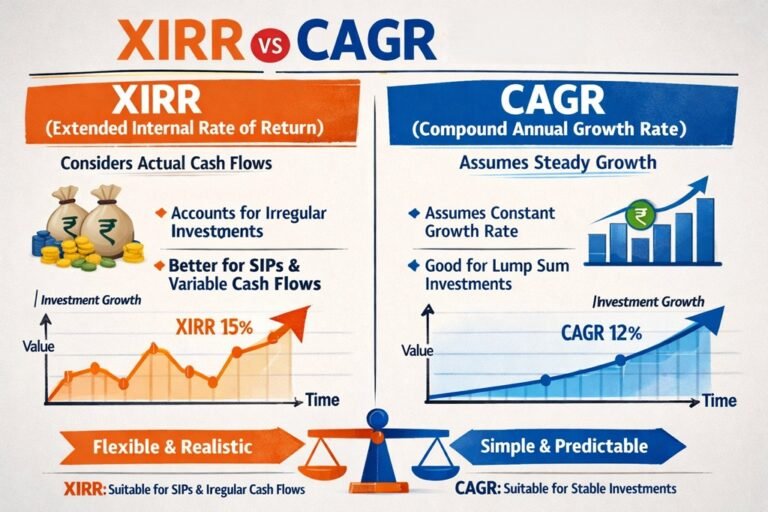
Measuring your performance becomes equally important whenever you choose a suitable investment vehicle. XIRR and CAGR are two popular metrics that can be used by you in order to measure the performance of your money. Even though both of these metrics will provide you with valuable information about how your money has grown over time, there are different investment situations where you need to use different measures.
This article is specifically designed for people who have no idea regarding which measure to use for calculating performance in case of SIP investments, lump sum investments, etc. Let’s see what these metrics mean, what’s the difference between them and how to calculate them.
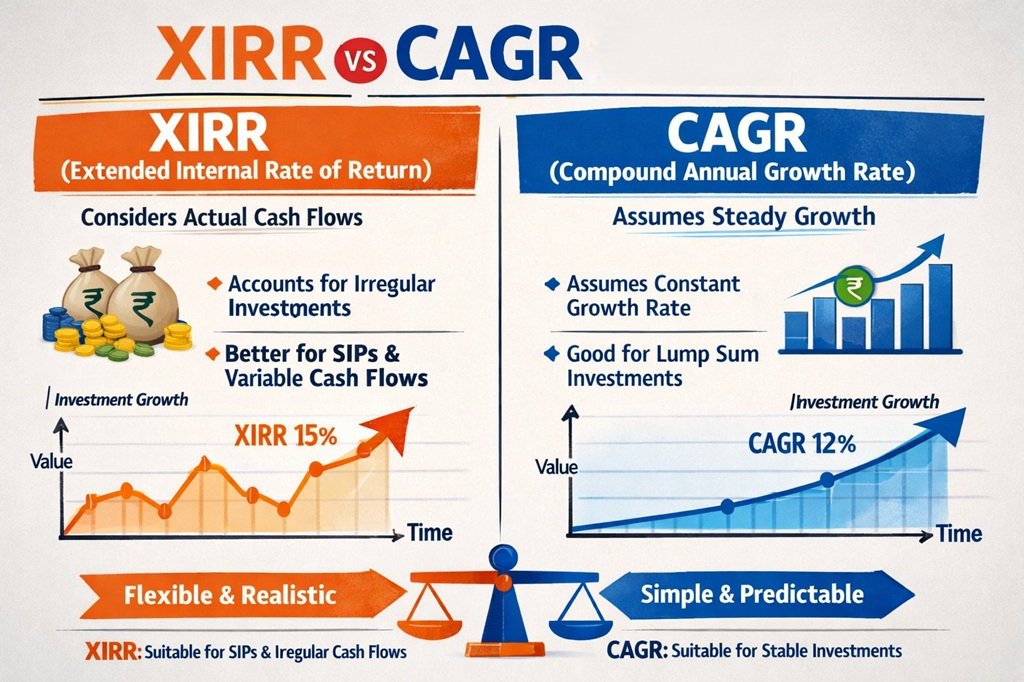
What is CAGR?
CAGR is the abbreviation for Compound Annual Growth Rate. CAGR is the growth rate of the investment for a specified period of time. This is the growth rate which is achieved by the investment in each year. In other words, CAGR takes into account the volatile nature of returns each year and gives a percentage figure of growth rate in annual figures.
The use of CAGR can be seen in the evaluation of investments, which have been done in one single transaction.
CAGR Formula
CAGR = (Ending Value / Beginning Value)^(1/n) − 1
Where:
- Ending Value = the final value of the investment
- Beginning Value = the initial amount invested
- n = number of years the investment was held
Example of CAGR Calculation
Suppose you invested ₹1,00,000 in a mutual fund, and after 5 years, the value grew to ₹1,80,000. Using the CAGR formula:
CAGR = (1,80,000 / 1,00,000)^(1/5) − 1 CAGR = (1.8)^(0.2) − 1 CAGR = 1.1247 − 1 CAGR = 0.1247, or 12.47%
This translates to an average yearly growth of 12.47% for the 5 years in question, despite the possibility that returns each year may have varied significantly.
What is XIRR?
XIRR refers to Extended Internal Rate of Return. In contrast to CAGR, which is effective only in case of investment of one single lump sum, XIRR is an indicator that can work with several cash flows coming at unequal intervals. Thus, XIRR is the best return calculation formula in case of SIPs (where investors make equal investments on a monthly basis) or portfolios having deposits and withdrawals at various points in time.
XIRR takes into account the exact dates of all cash flows (inflow and outflow) and calculates an annualized rate of return considering all transactions.
XIRR Formula
Unlike CAGR, there is no straightforward algebraic equation to work out XIRR. XIRR calculation involves the process of iteration, in which we find r from the below equation:
0 = Σ [CFi / (1 + r)^((di − d1)/365)]
Where:
- CFi = cash flow at time i (positive for inflows, negative for outflows)
- di = date of the i-th cash flow
- d1 = date of the first cash flow
- r = the rate of return we are solving for (XIRR)
As this formula depends on “r” being solved by trial and error (iterative approximation), XIRR is most of the time computed with the help of spreadsheet tools like Microsoft Excel or Google Sheets, which have the XIRR() formula embedded in them.
Example of XIRR Calculation
Let’s say you invested in a SIP with the following cash flows:
| Date | Cash Flow (₹) |
| 01-Jan-2021 | −10,000 (investment) |
| 01-Jan-2022 | −10,000 (investment) |
| 01-Jan-2023 | −10,000 (investment) |
| 01-Jan-2024 | 40,000 (redemption/current value) |
In Excel, you would enter these dates and cash flows into two columns and use the formula:
=XIRR(values, dates)
The annual rate of return will then be calculated by Excel after taking into account the precise date on which each transaction has taken place; something that is not possible with CAGR.
XIRR vs CAGR Differences
After understanding both the methods, now we will look into the comparison between both of them.
- Type of Cash Flows
- CAGR can work only with a single inflow of cash and a single outflow of cash – basically a lump sum invested at the beginning and withdrawn at the end.
- XIRR works with many cash flows occurring at different times, so it can be used for SIPs, staggered investments, and portfolio management with irregular investments and withdrawals.
- Complexity of Calculation
- CAGR can be calculated manually through an easy formula.
- XIRR needs iterative calculation, and hence it is calculated either through financial calculators or through Excel functions as there is no direct closed form formula for XIRR.
- Accuracy in Real World Scenario
- CAGR assumes smooth uniform growth rate that rarely happens in real world scenario. Also CAGR doesn’t consider multiple investments.
- XIRR is much realistic since it considers the exact dates of all transactions and thus captures the effect of the timing of inflows/outs of money from the investment.
- Areas of Application
- CAGR is used to compare the performances of two lump sum investments, determine revenue/earnings growth of a company over a number of years, or calculate the returns of a fixed deposit.
- XIRR is used to calculate the returns of SIPs, recurring deposits, insurance-based investments, or in portfolios where investments/withdrawals have been made at different times.
- Assumption of Growth Rate
- The CAGR method assumes that the investment grows at the same rate every year, something which is not true in case of equity markets, which are highly volatile.
- The XIRR method does not make an assumption about the rate of growth. Instead, it calculates the average annual rate of growth regardless of how volatile the process may have been.
When Should You Use CAGR?
CAGR works most effectively in scenarios that deal with only one investment made and analyzed once. These include:
- Analyzing the growth rate of an investment made in a mutual fund over a number of years
- Comparing the past performances of two or more stocks or mutual funds
- Measuring the growth rate of revenue, profits, or users of a company over a number of years
- Gaining insight into the growth trend of a fixed deposit or bond that matures at the end of its term
Since CAGR presents all the data as one smooth value, it is perfect for making fast comparisons but can give false information when used in case of investments that have more than one transaction.
When Should You Use XIRR?
XIRR is particularly useful in situations where there are multiple cash flows occurring at different points in time. Some applications are listed below:
- The calculation of the returns from SIPs in mutual funds
- The evaluation of RDs having periodic deposits
- The evaluation of the performance of a portfolio having periodic additions and partial withdrawals
- The evaluation of the returns of ULIPs (Unit Linked Insurance Plans) or any other investment cum insurance product having periodic premiums
- The comparison of the actual performance of a portfolio with benchmark indices when the method of investing in the portfolio is not one-time
For investors who invest regularly through SIPs, XIRR will provide a much clearer indication of the actual returns than CAGR ever could.
Why CAGR Can Be Misleading for SIP Investments
CAGR for SIP returns calculation is one of the most prevalent mistakes committed by new investors. The reason behind this is that SIP is a sequence of investments rather than a lump sum investment. This implies that CAGR cannot be used here because in case of SIPs, the cash flow pattern is complicated or else the rate of return generated using CAGR is incorrect.
The above statement can be justified using an example in which an investor makes ₹5,000 investment every month for three years. It means that there have been 36 SIP investments in three years having varying holding periods. The CAGR formula does not consider the point that the cash flow of the first month has been compounding for three years, while the cash flow of the last month has not had any time to compound.
CAGR vs XIRR
| Parameter | CAGR | XIRR |
| Best for | Lump sum investments | SIPs & multiple cash flows |
| Cash flow timing | Assumes single start and end | Considers exact dates of all flows |
| Calculation method | Simple formula | Iterative, needs software |
| Growth assumption | Constant annual growth | No fixed assumption |
| Common tools | Manual calculation, calculators | Excel/Google Sheets XIRR function |
| Accuracy for irregular investments | Low | High |
How to Calculate XIRR and CAGR in Excel
Both metrics can be easily calculated using Excel or Google Sheets:
For CAGR: Use the formula =(Ending Value/Beginning Value)^(1/n)-1, where “n” is the number of years.
For XIRR:
- List all your cash flows (investments as negative values, redemptions/current value as positive) in one column.
- List the corresponding dates in an adjacent column.
- Use the formula =XIRR(values, dates) to get the annualized return instantly.
This makes XIRR far more practical for real-world portfolios where money moves in and out at different times.
Final Thoughts
Although CAGR and XIRR are important concepts for measuring investment success, their application differs from case to case. While CAGR gives a quick measure to calculate the annualized return of an investment, it is appropriate when there is a single lump sum investment made. On the other hand, XIRR is the more complex tool which needs to be applied whenever there are several cash flows involved.
Applying the concept of XIRR and CAGR at the right time will help you understand how much you have actually gained in return of your investments. As a matter of fact, if you make investments through the route of SIPs, it is mandatory that you use XIRR to determine your returns. CAGR can be used for single lump sum investments or when there is an overall analysis of the trend.
In this way, understanding these two metrics will help you in taking wise investment decisions in the future.