

If you follow the stock market even casually, you have probably heard both these names — Sensex and Bankex. And if you have ever wondered why banking stocks sometimes shoot up while the rest of the market barely moves, or why the overall market rallies even when banks are struggling, then this article is for you.
Many investors, especially those who are new to the stock market, find it confusing that two indices from the same exchange can behave so differently.
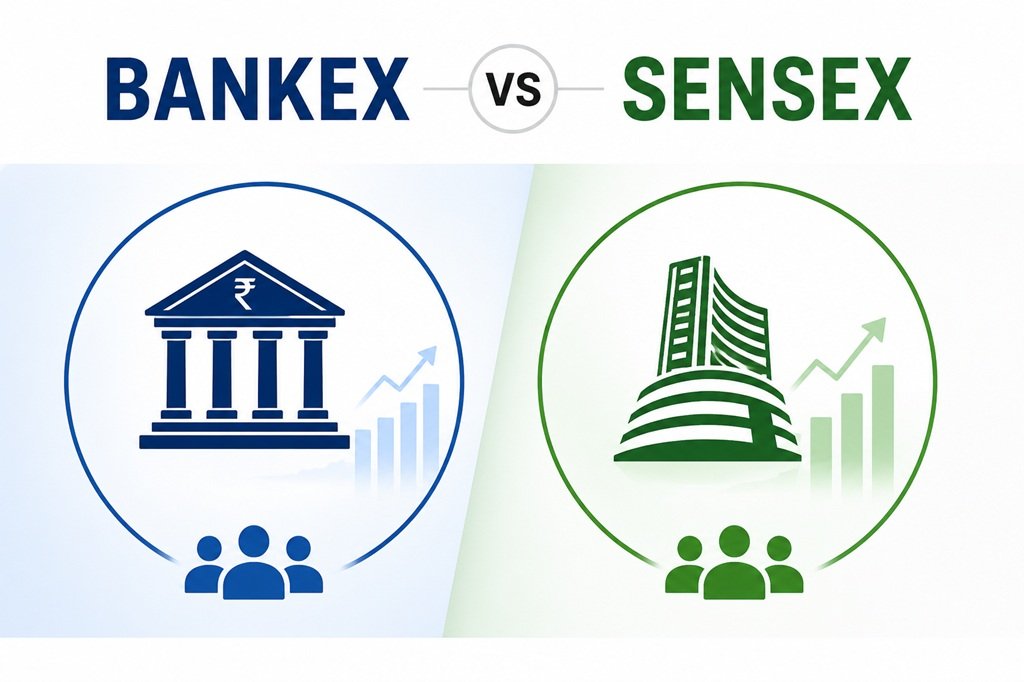
This leads to one of the most common questions asked by Indian retail investors: what exactly is the difference between Bankex and Sensex?
Understanding this difference is not just academic. It has real practical value for investors who want to make sense of market movements, evaluate sector-level trends, and make better-informed investment decisions.
What is Stock Market Index?
Before we get into Sensex and Bankex specifically, let’s quickly understand what a stock market index actually is — because everything else builds on this.
Think of a stock market index as a report card for a group of companies. Instead of tracking hundreds of individual stocks one by one, an index picks a representative set of companies and tracks them together. When the index goes up, it means those companies are collectively doing well. When it goes down, things are not looking great for that group.
India has two major stock exchanges — the Bombay Stock Exchange (BSE) and the National Stock Exchange (NSE). Both exchanges have their own set of indices. Sensex and Bankex are both BSE indices.
Now, indices can be of two broad types:
- Broad market indices — these track companies across many industries and give you a general idea of how the whole market is doing. Sensex is a great example of this.
- Sectoral indices — these focus on just one industry, like banking, IT, or pharma. Bankex is a sectoral index that covers only banking stocks.
What Is Sensex?
Sensex — the word itself is a combination of “Sensitive” and “Index” — is India’s oldest and most famous stock market benchmark. It was introduced in 1986 by the Bombay Stock Exchange, but its base year goes all the way back to 1978-79, when it started at a value of 100 points.
Today, Sensex tracks 30 large, financially strong, and highly liquid companies listed on the BSE. These are not random companies — they are selected because they represent the backbone of India’s economy. The list includes businesses from sectors like:
- Banking and financial services
- Information Technology (IT)
- Oil and Gas / Energy
- Fast Moving Consumer Goods (FMCG)
- Automobiles
- Healthcare and Pharmaceuticals
- Metals and Mining
- Telecom
Because Sensex includes companies from so many different sectors, it gives you a bird’s-eye view of how Corporate India as a whole is performing. When someone on the news says “the market was up 500 points today,” they are almost always talking about the Sensex.
Why Does Sensex Matter?
Sensex is important for several reasons:
It is a barometer of the economy. When companies across multiple sectors are growing, profits are rising, and investor confidence is high, Sensex goes up. And when businesses face trouble — whether from global slowdowns, inflation, or political uncertainty — Sensex tends to fall.
It is used as a benchmark. Mutual funds, portfolio managers, and institutional investors often measure their performance against the Sensex. If your portfolio returned 15% but Sensex returned 20% in the same period, your portfolio actually underperformed.
It influences global perception of India. Foreign investors watch the Sensex closely when deciding whether to invest in India. A rising Sensex signals a healthy, growing economy.
It captures investor sentiment. Markets are driven by both numbers and emotions. When optimism is high, people buy more stocks and Sensex rises. When fear sets in, selling increases and Sensex falls. This makes it a real-time pulse check on how investors are feeling.
What Is Bankex?
Bankex stands for “Bank Index” and it is the Bombay Stock Exchange’s flagship index for the banking sector. Unlike Sensex, which looks at the broader economy, Bankex keeps its focus exclusively on banks.
BSE officially launched Bankex on June 23, 2003. However, its historical performance is tracked back to January 1, 2002, which is its base date — starting at a value of 1,000 points.
As of mid-2026, Bankex consists of 14 banking stocks listed on the BSE. These are major public and private sector banks that play a significant role in India’s financial system. The index is reviewed and rebalanced twice a year — in June and December — to ensure that it continues to represent the most relevant banking stocks.
Why Is the Banking Sector So Important?
Banks are not just businesses — they are the backbone of any economy. Here is why:
- They give out loans. When a business needs money to expand, or when a family wants to buy a home, they go to a bank. The more banks lend, the more economic activity gets generated.
- They manage savings. Banks hold the savings of millions of Indians and deploy that money productively into the economy.
- They facilitate payments. Every transaction — from your UPI payment to a corporate fund transfer — runs through the banking system.
- They signal economic health. If banks are reporting strong loan growth and low bad loans (NPAs), it generally means the economy is doing well. If banks are struggling with rising defaults, it usually signals trouble in the broader economy too.
That is why Bankex is closely watched not just by stock market investors, but also by economists, policymakers, and businesses.
Key Features of Bankex at a Glance
- Tracks 14 leading banking stocks on BSE
- Launched with a base value of 1,000 points (January 1, 2002)
- Reviewed and rebalanced every six months (June and December)
- Uses free-float market capitalization methodology with a cap of 19% weight per stock
- Sensitive to RBI policy changes, interest rate movements, and credit growth trends
How Are Sensex and Bankex Calculated?
Both Sensex and Bankex use something called the free-float market capitalization methodology. Let’s break that down without the jargon.
Market Capitalization is simply the total value of a company’s shares. If a company has 10 crore shares and each share is priced at ₹500, then its market cap is ₹5,000 crore.
But not all of those shares are freely available in the market. Some are held by the founders (called promoters), the government, or large strategic investors who are not going to sell anytime soon. These shares do not reflect what ordinary investors in the market can actually buy or sell.
Free-float refers only to the shares that are actually available for trading by the general public.
So the formula works like this:
Free-Float Market Cap = Market Price × Total Shares Outstanding × Free-Float Factor
The “free-float factor” is a number between 0 and 1 that tells you what fraction of the company’s shares are freely tradable. A company with lots of promoter holding might have a free-float factor of 0.3 (only 30% of shares are available to the public), while a company with minimal promoter holding might be 0.8 or higher.
The index then adds up the free-float market caps of all its constituent companies and divides by a special number called the “index divisor” to arrive at the final index value.
Why does this matter? Because companies with a higher free-float market cap have a bigger impact on the index. This is a fair way to measure performance because it focuses on the value that is actually available to investors.
One important difference worth noting: Bankex applies a cap of 19% on the weight of any individual stock. This means no single bank can dominate the index too heavily, even if it is much larger than the others. Sensex does not have such a strict cap on individual stocks.
Bankex vs Sensex: Key Differences Explained
Here is a comparison that puts everything side by side:
| Feature | Sensex | Bankex |
| Type of Index | Broad Market Index | Sectoral Index |
| What It Tracks | Top 30 companies across multiple sectors | Top 14 banking stocks |
| Purpose | Reflects overall market performance | Reflects banking sector performance |
| Started With | 100 points (base year: 1978-79) | 1,000 points (base date: January 1, 2002) |
| Launch Date | 1986 | June 23, 2003 |
| Sector Exposure | Diversified (banking, IT, FMCG, auto, etc.) | Banking only |
| Methodology | Free-float market capitalization | Free-float market cap with 19% individual cap |
| Sensitivity to RBI Policy | Moderate | Very High |
| Best Used For | Gauging overall market direction | Gauging banking sector health |
| Rebalancing | Periodic review | Every 6 months (June & December) |
| Economic Indicator | Overall economic activity | Banking and credit activity |
A Real-World Example to Make This Click
Let’s say the Reserve Bank of India (RBI) announces a cut in the repo rate — the rate at which it lends money to banks.
When the repo rate falls, banks can borrow money more cheaply from the RBI. This often leads to:
- Lower lending rates for home loans, business loans, and personal loans
- Higher demand for credit from consumers and businesses
- Improved profit margins for banks on their existing loan books
As a result, banking stocks tend to react positively to a repo rate cut. Bankex would likely go up.
But what about Sensex? The impact would be more mixed. Lower rates help banks, but IT companies may not benefit directly. FMCG companies are not immediately affected. Healthcare companies may see little change. So Sensex may rise, but perhaps not as sharply as Bankex.
Now flip the scenario. Suppose there is a global technology boom and Indian IT companies are landing massive new contracts. IT stocks surge. Consumer goods companies also do well because people have more money to spend. But banks are struggling with rising non-performing assets (bad loans) due to stress in certain sectors.
In this case, Sensex might go up significantly — driven by IT and consumer stocks — even while Bankex underperforms because of banking sector stress.
This is exactly why the two indices can move very differently even on the same day.
What Moves Sensex More?
- Global events: A recession in the US or a spike in oil prices affects many sectors of the Indian economy simultaneously.
- GDP growth data: Strong economic growth numbers tend to lift most sectors.
- Inflation: High inflation can hurt consumer spending and corporate margins across industries.
- Budget and government policies: Tax changes, infrastructure spending, and reforms affect multiple sectors.
- Corporate earnings season: Results from large companies in IT, FMCG, auto, and banking all contribute to Sensex movement.
- Foreign Institutional Investor (FII) flows: FIIs invest across sectors, so their buying or selling broadly impacts the market.
What Moves Bankex More?
- RBI’s monetary policy: Interest rate decisions have a very direct effect on banks’ profitability and loan demand.
- Repo rate and reverse repo rate: These determine the cost of funds for banks.
- Credit growth: If total bank lending is growing fast, banking stocks usually do well.
- Non-Performing Assets (NPA) data: Rising bad loans hurt banks significantly. NPA announcements can cause big moves in Bankex.
- SEBI and RBI regulations: New rules around capital requirements, provisioning norms, or lending caps can directly affect banking stocks.
- Asset quality reviews: Periodic checks on how healthy bank loan books are can trigger sector-specific moves.
- Mergers and restructuring in the banking sector: Announcements of bank mergers, privatization plans, or government recapitalization of public sector banks can cause Bankex to move sharply.
Bankex vs Nifty Bank: Are They the Same?
Many investors get confused between Bankex (BSE) and Nifty Bank (NSE). Both track banking stocks, but they are different indices from different exchanges.
| Feature | Bankex | Nifty Bank |
| Exchange | BSE (Bombay Stock Exchange) | NSE (National Stock Exchange) |
| Number of Stocks | 14 | 12 |
| Base Value | 1,000 (Jan 1, 2002) | 1,000 (Jan 1, 2000) |
| Primary Use | BSE banking benchmark | NSE banking benchmark |
| Derivatives | BSE Bankex futures & options available | Very liquid F&O market on NSE |
Both indices often move in the same direction since they track the same sector. However, the specific stocks and their weightings can differ slightly, which is why their returns are not always identical.
For options traders, Nifty Bank (also called Bank Nifty) is extremely popular because of its highly liquid derivatives market on NSE. For BSE-focused investors and those tracking BSE instruments, Bankex is the go-to banking benchmark.
Why Smart Investors Track Both Indices Together
Here is a simple way to think about it: if Sensex is the big picture and Bankex is the close-up view of banking, then looking at both together gives you the clearest picture of what is happening in the market.
Consider these scenarios:
Scenario 1: Both Sensex and Bankex are rising strongly This usually signals broad-based economic optimism. Banks are doing well, non-banking companies are doing well, credit is flowing, and corporate earnings are strong. This is generally a good environment for equity investments.
Scenario 2: Sensex is rising but Bankex is lagging This tells you that the market rally is being driven by non-banking sectors — perhaps IT, pharma, or consumer goods. Banks may be facing sector-specific headwinds like rising bad loans or regulatory tightening. Investors with heavy bank exposure should pay attention.
Scenario 3: Bankex is rising sharply but Sensex is flat The banking sector is likely responding to something specific — maybe an RBI rate cut, a government capital infusion into public sector banks, or strong quarterly results from major banks. Other sectors are not participating yet.
Scenario 4: Both are falling Broad market stress. This could indicate global risk-off sentiment, a sharp economic slowdown, or a major macro event affecting the entire market.
By reading both indices together, you get signals that you would miss if you only watched one.
What Does a Rising Bankex Tell Us About the Economy?
When Bankex is trending up over a sustained period, it often signals:
- Credit growth is healthy: Businesses are borrowing to expand, and consumers are taking loans for homes, cars, and education.
- Bank balance sheets are clean: NPA ratios are under control, and banks are not sitting on piles of bad debt.
- Monetary policy is supportive: Interest rates are at levels that encourage lending without squeezing bank margins.
- Economic confidence is high: Companies see enough business opportunity to take on debt for expansion.
On the flip side, when Bankex is under pressure, it often signals:
- Rising stress in the loan books of banks
- Higher interest rates squeezing borrowers and slowing credit demand
- Regulatory actions or compliance issues in the banking sector
- Economic slowdown affecting businesses’ ability to repay loans
This is why economists and analysts watch Bankex closely as one of the early-warning systems for broader economic health.
How to Use This Knowledge as an Investor
You do not need to be a professional analyst to benefit from understanding Sensex and Bankex. Here are some practical takeaways:
- Do not rely on just one index to understand the market. Sensex gives you the big picture; Bankex tells you about the most economically sensitive sector. Use both.
- Watch Bankex around RBI policy announcements. When the RBI’s Monetary Policy Committee (MPC) meets, its decisions on interest rates directly affect Bankex. Plan accordingly if you have heavy exposure to banking stocks.
- If you are building a diversified portfolio, the Sensex composition gives you a great template of which sectors matter at any given time.
- For sector-specific bets, Bankex is your benchmark. If you believe the banking sector will outperform the broad market, you can track Bankex to validate that thesis.
- Be cautious about short-term noise. Both indices can be volatile in the short term due to global events, news flows, and speculation. Long-term trends in both indices tend to reflect genuine economic fundamentals.
Conclusion
Sensex and Bankex are both important BSE indices, but they serve very different purposes.
Sensex is like looking at India’s economy through a wide-angle lens — it shows you the performance of 30 leading companies across multiple sectors. It tells you whether Corporate India as a whole is flourishing or struggling.
Bankex is a zoom-in on one of the most critical sectors in the economy — banking. It tracks 14 leading banking stocks and gives you a precise view of how India’s banks are doing at any given time. And since banks are central to economic activity — powering lending, credit creation, and financial transactions — Bankex is also a reflection of economic health itself.
Rather than thinking of them as competing tools, think of Sensex and Bankex as complementary. Together, they give you a more complete and nuanced understanding of the Indian market than either could provide alone.
Whether you are a beginner just starting your investing journey or an experienced investor trying to fine-tune your market reads, tracking both Sensex and Bankex will help you make better sense of what is happening — and make smarter investment decisions.
Frequently Asked Questions (FAQs)
Q1. What is the main difference between Bankex and Sensex?
Sensex tracks 30 companies across multiple sectors and represents the overall Indian stock market. Bankex tracks only 14 banking sector stocks and represents the performance of India’s banking industry. Sensex gives you the big picture; Bankex gives you a sector-specific view.
Q2. Which index is more diversified?
Sensex is far more diversified. It includes companies from banking, IT, FMCG, healthcare, energy, automobiles, metals, and telecom. Bankex focuses only on the banking sector, making it a concentrated sectoral index.
Q3. Is Bankex more sensitive to RBI’s interest rate decisions than Sensex?
Yes, significantly so. Since Bankex consists entirely of banking stocks, changes in the repo rate, reverse repo rate, or other RBI policy decisions affect it much more directly than Sensex. Interest rate changes influence banks’ borrowing costs, lending rates, and ultimately their profitability.
Q4. How many stocks does Bankex currently have?
As of June 2026, Bankex consists of 14 banking stocks listed on the BSE. It is reviewed and rebalanced every six months — in June and December.
Q5. Can Bankex rise even when Sensex falls?
Yes, it can. If the banking sector receives a positive trigger — such as a rate cut, strong quarterly earnings, or a government policy announcement — while other sectors face headwinds, Bankex could rise even if the broader Sensex falls.
Q6. What is the base value and base date for Bankex?
Bankex started at a base value of 1,000 points, with January 1, 2002 as its base date. It was officially launched by BSE on June 23, 2003.
Q7. Is Bankex the same as Nifty Bank?
No. Both track banking stocks, but Bankex is from BSE (Bombay Stock Exchange) while Nifty Bank (or Bank Nifty) is from NSE (National Stock Exchange). They may include slightly different stocks and have different compositions.
Q8. Why do analysts watch Bankex during economic recoveries?
Banks are central to economic recoveries because they provide the credit that businesses and individuals need to invest and spend. A rising Bankex during an economic recovery signals that lending is picking up, balance sheets are healthy, and the financial system is functioning well — all of which support broader economic growth.
Q9. Which index should a long-term investor track?
Most long-term investors benefit from tracking both. Sensex provides a broad view of overall market performance, while Bankex offers deeper insights into the financial sector — one of the largest components of the Indian economy. Together, they help build a more informed investment strategy.

