

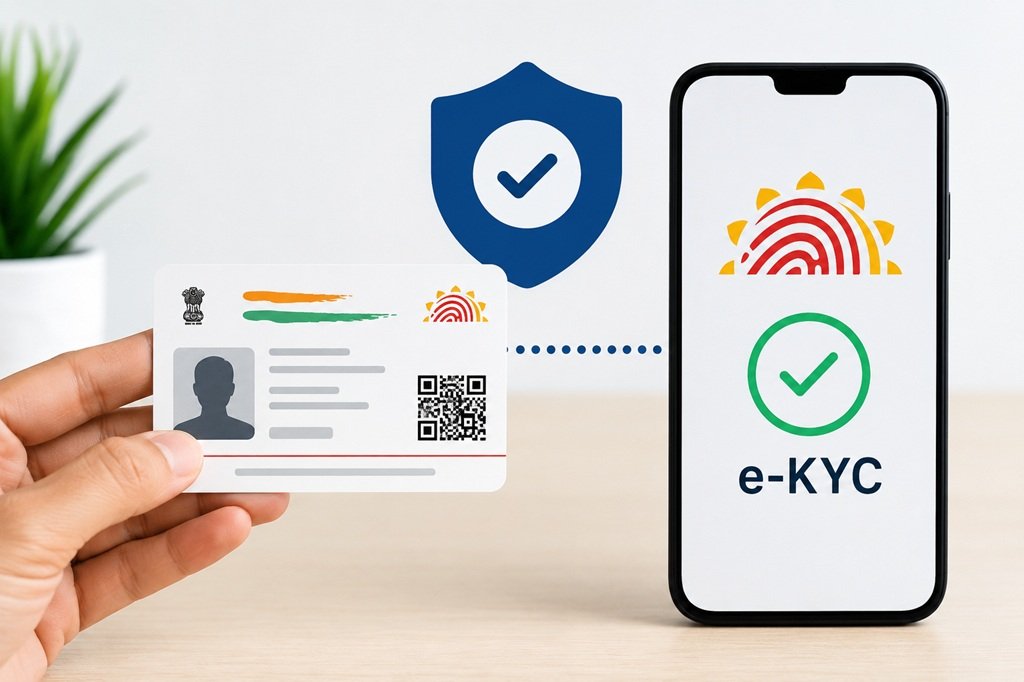
Having an account in a bank, purchasing SIM cards, mutual funds, or insurance in India anytime within the last decade, you must have come across the term “e-KYC”. At first glance, it may appear complicated; however, the idea is quite simple – rather than filling up physical forms and waiting in long queues with photocopied copies of identification documents, you complete the process online using your Aadhaar number.
In this guide, we will explore what e-KYC actually means, how it works, why it is used, where it is needed, and what you need to keep in mind concerning its potential pitfalls and shortcomings. We will try to explain the topic to you as clearly as if talking to a friend, without assuming any prior knowledge of how the banking or telecom industry functions.
What is KYC?
Before discussing the “e” part, it may be helpful to know more about KYC in general. In simple terms, KYC stands for “Know Your Customer”. Banks, financial institutions, telecom companies and any other business entities that come under regulatory scrutiny are supposed to carry out KYC procedures in order to allow customers to avail their services.
The basic idea behind this procedure is that the companies have to be sure of whom they are doing business with. The necessity of conducting this process does not lie in any formality but it is primarily done to avoid money laundering, terrorism financing, identity theft and other fraudulent activities. For instance, it will be very easy to misuse the banking system if people could easily open accounts using false identities without any kind of verification.
In general, KYC referred to the physical submission of certain documents such as proof of identity (PAN card or passport), proof of address (utility bill or ration card), and a passport size photograph. All these documents were checked by the bank representative against the original copies, verified, and filed. The process, nowadays called physical KYC to differentiate it from e-KYC, took several days, sometimes even weeks.
What is e-KYC?
E-KYC stands for “electronic Know Your Customer” which is nothing but an online or electronic form of this very KYC process wherein the identity of the customer is confirmed not through any physical document but through information available with the government, mostly through the Aadhaar database of the Unique Identification Authority of India (UIDAI).
In essence, there can be one of the two cases in e-KYC:
Either you provide your Aadhaar number to your service provider such as banks and telecom operators, or
The service provider sends your details to UIDAI’s servers, provided you give your permission for this. This will be done through an OTP to your registered mobile number or even through your fingerprints or iris scan at a verification point.
If all this gets completed successfully, UIDAI will then provide you with your basic demographic details which include your name, address, date of birth, gender, and picture.
The entire process typically takes a few minutes, compared to the days or weeks a manual process might take.
Why Aadhaar Only?
Aadhaar is a 12-digit Unique ID card issued to citizens of India by the Unique Identification Authority of India. It is based on a combination of demographic data, including name, address, and date of birth, along with biometric data such as fingerprints and an image of the eye retina. Since Aadhaar includes practically the entire Indian population and is connected to a digital database, it became the backbone of e-KYC when regulators and businesses started seeking means of faster verification of people’s identities.
Prior to the adoption of Aadhaar-based e-KYC, the process of identity verification relied on physical papers, which were vulnerable to forgery or alteration, and could not be verified quickly, especially if people had moved to other parts of the country. The introduction of biometric data in Aadhaar provided one more stage of verification, virtually impossible to falsify in practice.
Different Types of Aadhaar-Based e-KYC
The Aadhaar-based e-KYC does not have only one variant. Several options have emerged over time for this procedure, partly due to various legal issues and privacy concerns (more about them later).
- OTP-Based e-KYC
It is the variant of e-KYC that is used in most cases and is well known to many people. You provide your Aadhaar number and get the one-time password sent to the mobile number that was registered with your Aadhaar card. You enter your OTP and get your identity verified based on it, along with getting your demographics disclosed to the service provider. It is a quick way that does not require any specific equipment except a phone with reception.
Example – ITR Filing Verification, SIM Card Activation
- Biometric e-KYC
In this case, instead of OTP, your fingerprint or iris is scanned using a fingerprint or an iris scanner respectively, usually at a particular physical location like a bank or a telecommunications shop. It is perceived as a more reliable form of authentication, as biometric information cannot be duplicated or transferred to someone else compared to OTP.
Example – Direct Benefit Transfer
- Offline e-KYC (Using Aadhaar XML/QR)
This was designed specifically to tackle privacy issues. Rather than a company querying UIDAI’s servers directly using your Aadhaar number, you prepare an encrypted and password-protected XML file (or QR code) yourself via the UIDAI website. The file will contain your demographic data but not your Aadhaar number; rather, you will get a masked or reference number in it. You will pass on this file to the relevant people who want to verify your identity without having to query UIDAI’s servers at all.
Example – Bank Account Opening, Mutual Fund e-KYC
Step-by-Step e-KYC process
To make things more concrete, here’s a rundown of how OTP-based e-KYC works, for example, when using a mobile app to open a bank account:
- You put your Aadhaar number into the app or website.
- The service provider initiates an authentication request to UIDAI, and asks your permission (you’ll usually see a checkbox for this, or a consent screen).
- UIDAI sends you an OTP to your mobile phone number registered with your Aadhaar.
- You enter this OTP back into the app.
- UIDAI verifies the OTP and authenticates your identity, sending your name, address, date of birth, gender, and photo (not your fingerprint or iris scan data, and, in most consumer-facing instances, not your Aadhaar number either — just your masked Aadhaar number) to the service provider.
- The service provider automatically fills up your details onto their registration form.
- You check these details, add any further necessary information, and submit.
- Your account, SIM, or insurance policy gets activated.
- In case of biometric KYC, you need to put your finger or biometric in order to do verification.
Advantages of e-KYC
Speed – Processes that earlier took days could now be accomplished within minutes. This would particularly come in handy for instances like SIM activation or opening a bank account, where waiting would not be very practical.
Convenience – Physical visits to branches or offices, carrying photocopies, and having documents attested would no longer be necessary. All of this can be done using one’s smartphone.
Less paper work – There would be less use of printers, less physical storage of confidential documents by firms, and fewer cases of loss or damage of paper work.
Decrease in costs for the firms – Fewer manual processes of verification would mean decreased cost of operation for the banks and other firms, and this, in theory, would result in better customer service or lower fees for the clients.
Decreased identity fraud to some extent – Since it would be difficult to counterfeit Aadhaar biometric data, biometric e-KYC, in particular, provides an additional level of security that paper documents cannot offer.
Financial inclusion – e-KYC has been instrumental in allowing people residing in distant places to open bank accounts and avail themselves of financial products and services without visiting branches.
Conclusion
e-KYC has gradually become one of the most critical infrastructures in India’s financial and telecom domain. It has not only made everyday activities such as bank account opening and activation of SIM cards much easier but has indeed helped in providing access to financial products to those who had difficulty in doing so before.
However, it is important to remember that e-KYC is based on a system that works with very sensitive data related to individuals along with their biometrics, which indeed comes with its own set of risks as well as responsibilities. Having an understanding of the whole procedure and being aware of all your rights, including offline verification, helps you take advantage of these systems in a safer way.

