

Bookkeeping is an essential process for any business. All businesses, no matter whether it is a start-up company or a huge corporation, should have their financial records to track the income, expenses, profit, tax payment, and cash flow. But not all the accounting mistakes are harmless. In some situations, small bookkeeping discrepancies may turn into financial misbehavior or even fraud.
The omission of an expense, the mistake of the invoice calculation, or the double booking of the transactions may appear to be an insignificant issue at first sight. But when a person intentionally manipulates with the financial records of the company, hiding its income, inventing some fake expenses, making some false calculations to show that the company is more profitable – then it is already a serious problem. The difference between bookkeeping error and fraud is the intentional character of the actions and the deceitfulness.
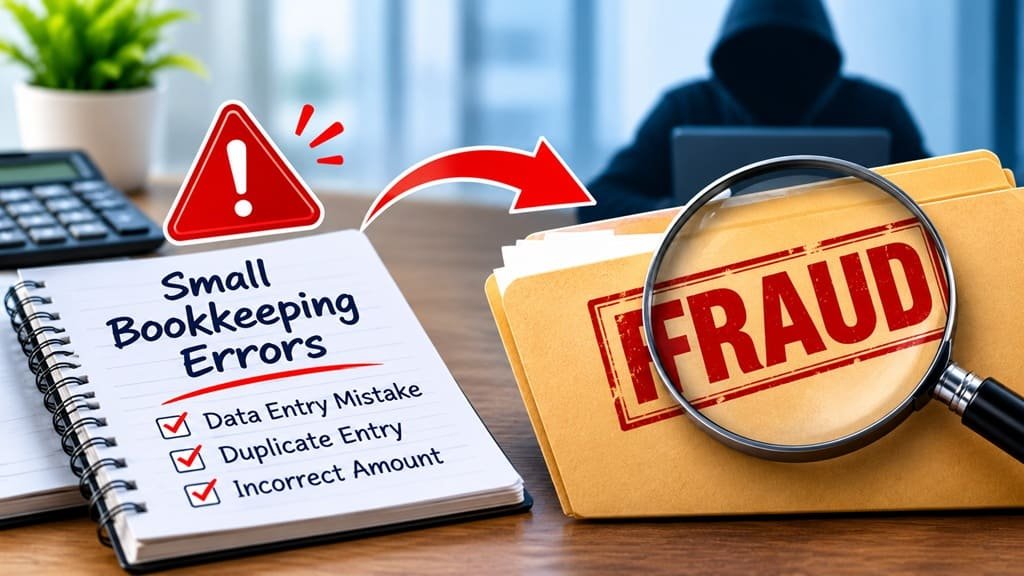
It is very important for the small business owners, accountants, bookkeepers, and other finance specialists to distinguish between these two terms. Even a tiny accounting discrepancy may lead to such consequences as penalties from taxes, financial loss, harm to the company’s reputation, and others.
In this article, we will examine accounting or bookkeeping mistakes that may become frauds, the red flags that should be paid attention to, and ways to avoid them.
Inaccurate Balance Sheets vs Intentional Deception
A balance sheet can be wrong because someone entered a figure twice, used the wrong account code or failed to record a liability. These common accounting errors usually leave an audit trail and can be corrected through a documented adjustment. An article examining how manual spreadsheet processes can undermine corporate balance sheets also highlights how overwritten formulas, inconsistent files and missing audit trails can contribute to financial reporting errors.
Intentional deception occurs when someone knowingly provides false information for personal gain or in order to hide a problem. This includes such things as creating fictitious receivables, the deliberate delay in recording debts, and altering invoices prior to the start of an audit. In evaluating fraud or incompetence, the person(s) who gained from it, the frequency with which it happened, and whether employees were warned about it before could be considered.
Common Revenue Recognition Missteps
Revenue Recognition becomes difficult because some companies record revenues before they earn it. For example, a customer pays $24,000 for a service in December for 12 months starting in January. Recording the total revenue in December is overstating its performance. The money usually has to be accounted for throughout the duration of the service in accordance with the accounting requirements.
Others errors are recording unsigned contract as sales, recording refundable payments as income or maintaining cancelled orders in sales account. Meeting the goal set by the lender or getting a performance bonus makes this error even more dangerous.
Establishing a set of criteria for revenue recognition and requiring a proof for the transaction that seems abnormal is necessary. Monthly reconciliation process has to be made by comparing the invoices with the contracts, deliveries and refunds.
When Discrepancies Trigger Enforcement Action
A single discrepancy correction will often not provide the complete picture. Risk factors include where there is a trend; the management is informed about the risk but does not intervene; the records get destroyed after there are queries; and where false information is provided to the investors, the lenders, the tax authorities or the regulators.
Keep emails, invoices, approvals, earlier drafts of spreadsheets from the moment that an important problem has occurred. Do not change the explanations retrospectively; never make your employees reconcile their stories. UK companies’ directors and persons who find themselves under investigation need help from a professional fraud solicitor to deal with formal demands or notifications.
The initial investigation needs to define the sum, dates, decision-makers, and people to whom the wrong information was disseminated.
Establish Strong Internal Financial Controls
Separate financial responsibilities so no one individual can create a vendor record, approve an invoice and issue payment. Smaller organizations with fewer employees can utilize owner review, bank alerts, and spending limits to achieve the same separation of duties.
Regularly reconcile bank, accounts receivable and payable accounts. Research older account balances, round number entries, and journal entries posted just before or during close of business. Every manual adjustment must show the entry, who prepared it, who approved it, and the reasons and documentation supporting it.
Access control is also important. Employees should have only those permissions necessary for their job and any excess access should be quickly removed once changes to an individual’s duties occur. Routine surprise checks from outside of the bookkeeping department can be scheduled as well. A private method of filing complaints can be utilized by the staff to address suspicious entries before they get into tax reports and financial statements.
The accuracy of records will always rely on the actions that follow after an issue is discovered. Record the fix, state the cause of the issue, and document the control change that was implemented in order to avoid recurrence. This record could be used at a later date by an auditor or investigator to prove that the company took the issue seriously.

