

Silver investment in India has always been favored by people, irrespective of whether it was in coins, bar, jewelry or any other form of the physical metal itself. However, nowadays, there are additional means available for people who want to invest in silver – Silver ETFs. Through this investment tool, you can invest in silver without even having the physical metal.
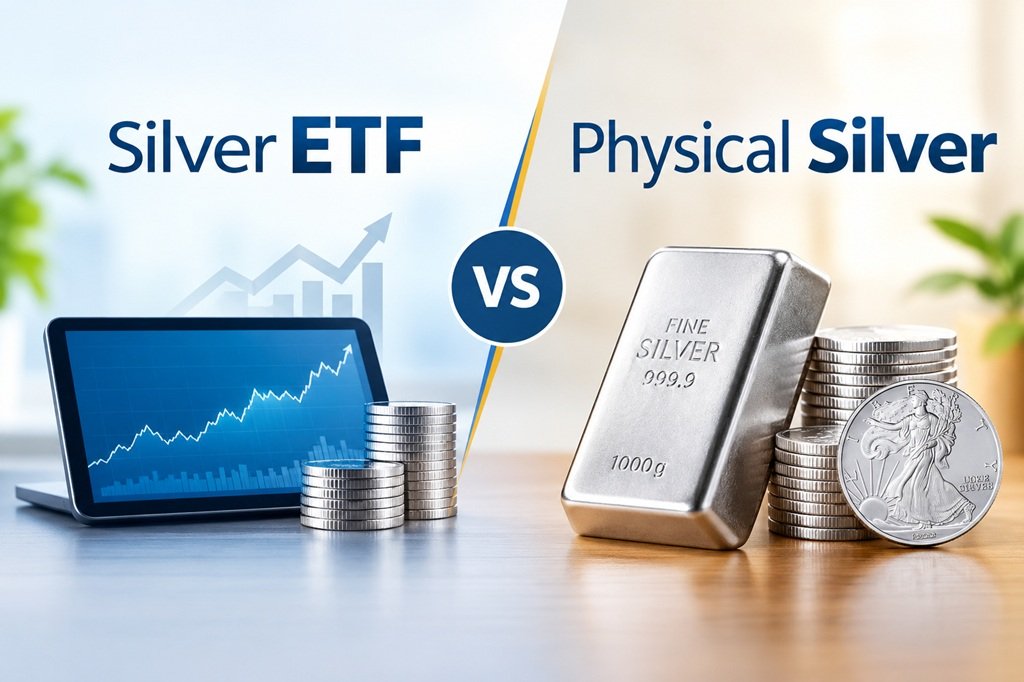
Therefore, which one to choose – Silver ETF vs Physical Silver? As physical silver provides you with ownership and the sense of owning something tangible, Silver ETFs provide you with all the conveniences. Still, both these choices come with their costs, risks, and taxation issues.
This article aims to compare Silver ETF vs Physical Silver with regard to investment cost, storage, liquidity, purity, taxes, ease of access, and returns on investment.
What is a Silver ETF?
Silver ETF, which stands for Exchange Traded Funds, is an investment instrument that is meant to mimic the price of silver. Instead of having to purchase silver bars or coins, and keeping them either at home or in a safety deposit box, investors have the choice of buying Silver ETF units through a stock exchange with the help of a demat and trading account.
Typically, the silver that the ETF holds is of specified purity, and the units of the ETF usually follow the same price pattern as that of the domestic silver price, taking into consideration costs and tracking errors.
For instance, if one intends to invest ₹50,000 in silver, then the person does not necessarily have to buy and store ₹50,000 worth of physical silver. One may invest the money in Silver ETF.
Silver ETF Key Features –
- Exchange traded: The units are traded on the stock market.
- Does not require storage: No need for you to store the metal physically in your house.
- Worries about purity level: The management of the fund takes care of the silver within the framework of its investment policy.
- Comparatively easy to handle: Buying and selling can be easily accomplished using a trading account.
- Value based on market performance: The price of the ETF is likely to move along with the price of silver, but it may trade at a small premium or discount against its intrinsic value.
- Costs associated with: Trading costs for the investors and expense ratio for the fund.
Physical Silver
Physical silver is real silver which is purchased by investors in tangible form. This should be differentiated from Silver ETF, which is an investment unit whose value is tied to the silver price.
The most common forms of purchasing physical silver include purchasing silver bullions, silver coins, silver biscuits or silver jewelry. The price charged will depend on the current silver price, purity, weight, manufacturing charges, or dealer charges, and taxes.
For instance, when you buy 1 kg silver bullion, the physical ownership is the 1 kg of silver. You can store it in your home, locker in a bank, or anywhere else safe.
Physical Silver Key Features –
- Ownership: You are the owner of the actual silver metal.
- Tangible item: In contrast to the ETFs, you can possess the silver in its physical form.
- Demat account unnecessary: You can purchase the silver directly from a reputed jeweller/bullion dealer.
- Need for storage: You have to make arrangements for storage as well as face security risks.
- Quality of purity: Purity and quality need to be verified with proper invoice/certificate as the case may be.
- Cost factors: Margins of dealers, making costs of jewellery items and price disparity can influence the actual rate of return.
- Liquidity issues: It might not be as easy to sell as an exchange traded security.
Silver ETF vs Physical Silver Differences
Liquidity
The liquidity of the Silver ETF wins hands down. You can buy or sell it immediately while trading in your demat account when the markets are open. Whereas physical silver requires you to look for someone to sell the silver, bargain over the price and even get it checked for purity in many cases before the deal can be struck.
Purity issues
As far as purity is concerned, you do not have to worry about it as it is guaranteed to meet certain minimum purity levels by the fund itself which are usually 99.9% pure silver. However, in case of physical silver, there is the risk of being cheated. You see not all jewelers are always trustworthy.
Storage and Security
This is a no-brainer. Silver ETF eliminates any worries of having to find places to store your silver. You don’t have to worry about buying lockers or paying insurance fees for fear of theft. It is important that physical silver be stored somewhere and the costs of storage vary depending on how much silver you own.
Cost of Making and Other Expenses
When purchasing physical silver, especially in the form of jewelry, making charges may account for as high as 8% to 25% of your total cost of purchase! This is quite a substantial amount which could otherwise have earned returns from the appreciation of the price of silver.
Taxation Perspective
And here comes the part where we need to get into some details because it is better to get help from a tax consultant in order to understand the technicalities better. But as far as the general guidelines are concerned, both physical silver as well as Silver ETF units will incur capital gain taxes depending upon the tenure held.
Investment Minimum Requirement
And when you think of investing in silver and starting with minimal investments, then you should opt for a Silver ETF as it allows you to start from scratch — meaning that you can invest in just a few units worth a few hundreds of rupees.
Why Some Indian Investors Are Going For Silver ETF Options
Times are changing, and so are the ways in which individuals invest their money. There is a new trend emerging in today’s world, whereby a number of investors, particularly the youth, are embracing online investments which do not require physical care at all. The Silver ETF makes a great choice for this sort of investment.
The advantages of Silver ETFs include:
- The ability to track the value of your investment in real time.
- The ease of investing from your smartphone or computer.
- There is no chance of dealing with fakes and fraudsters.
- Diversification of your investment portfolio without having to make a large payment.
- Investing in the stock market while using a single platform.
- It makes online investing convenient for you without any hassles.
When Physical Silver Still Makes Sense
And now, please do not misunderstand me — by no means is physical silver redundant. There are some cases when it actually becomes relevant:
- You require the precious metal for some religious or ritualistic purposes (marriages, festivals, and so on), which means that you definitely require the physical one.
- You simply do not trust anything digital and feel like holding your investment physically in your hands.
- When you intend to gift silver items, since there is literally nothing that can be “gifted” out of digital tokens.
- If collecting rare coins or historical silver pieces is your hobby.
So basically, it is all about the purpose of your investment. If you consider the investment only aspect, then the silver ETF is your way to go.
How to Choose Between Silver ETF and Physical Silver
To be honest, there is no one-size-fits-all answer to this question as it all depends on what you are looking for. To clarify your choice, ask yourself the following questions:
- Am I buying silver only for investment purposes or for practical usage?
- Am I comfortable with online trading platforms?
- Do I have sufficient storage capabilities for my physical silver?
- Am I willing to see fees cut into my profits?
- Is liquidity an important factor for me?
Once you’ve found the answers to these questions, the decision will most likely become evident to you. And let me add, there is nothing preventing you from buying both at once. Many people keep part of their silver in a Silver ETF while another part is kept physically.
Silver ETF vs Physical Silver – Summary
| Factor | Silver ETF | Physical Silver |
| Ownership | Own ETF units linked to silver | Directly own the physical metal |
| How to Buy | Through a demat and trading account | From jewellers, bullion dealers, or other sellers |
| Storage | No personal storage required | Requires safe storage |
| Purity Risk | Managed by the fund as per its mandate | Buyer needs to verify purity |
| Liquidity | Generally easy to buy and sell during market hours | Depends on the buyer/dealer and market conditions |
| Transaction Costs | Brokerage and fund-related expenses may apply | Dealer margin, making charges, and other costs may apply |
| Convenience | High; digital investment | Lower; requires handling and storage |
| Minimum Investment | Can generally start with a small number of ETF units | Depends on the weight and form purchased |
| Physical Possession | No | Yes |
| Price Tracking | Generally tracks silver prices, subject to expenses and tracking difference | Directly exposed to the value of the silver you own |
| Risk of Theft/Loss | No personal physical theft risk | Requires protection against theft or loss |
| Suitable For | Investors seeking convenient silver exposure | Investors who prefer owning tangible silver |
Frequently Asked Questions
Is a Silver ETF safe compared to physical silver?
In terms of security from theft and purity, yes; a Silver ETF will prove to be safer since there is no risk of theft and it will always provide pure silver. However, its risk of fluctuations in the markets is also high.
Can I convert my Silver ETF units into physical silver?
Usually not. Very rarely does any Silver ETF allow physical delivery of the product to the retail investors, so it is advised to check with your fund provider first.
Which provides higher returns – Silver ETF or physical silver?
Return on investment depends mainly on the change in the price of silver in the market, which impacts both investments equally. However, Silver ETF provides better return because of lower cost such as making charges.
Do I require a demat account for purchasing a Silver ETF?
Yes, it is required to have a demat account to be able to purchase Silver ETF units as well as trade on them.
Does physical silver work as a hedge against inflation?
Generally speaking, silver (in whatever form) acts as a good hedge against inflation.
Conclusion
All things considered, there is no clear winner between Silver ETF and physical silver – it all comes down to what will truly suit your needs and objectives. While the former option might be the right choice if you want ease, low costs, and liquidity, there is nothing wrong with opting for the latter one if you prefer tradition and sentiment over anything else.
Just remember to do your research before making a decision. Learn the risks involved in your chosen option, see whether or not you can afford to diversify your investments a little bit, and do everything in your power to ensure you know what you are getting yourself into. Good investing is never about being trendy – it’s about doing what really works for you.

