

Bombay Stock Exchange Index Services Pvt.Ltd, a subsidiary company of BSE, has created “BSE Saatvik 100 Index”. As per this index, those companies shall be disqualified whose activities are not saatvik. This means companies that are doing business related to alcohol, gambling, tobacco, leather, meat, pesticides or drugs and related products are not allowed to participate in this index. The top stocks weightage of this index is in HDFC Bank, ICICI Bank & Reliance. Let’s us explore what is saativk index, why it is required and how it is helpful while investing.
The Saatvik 100 Index of BSE includes those companies which are in consonance with Saatvik values like Non Violence (Ahimsa), Mercy to all living things, and abstaining from poison or addiction-causing goods and practices.
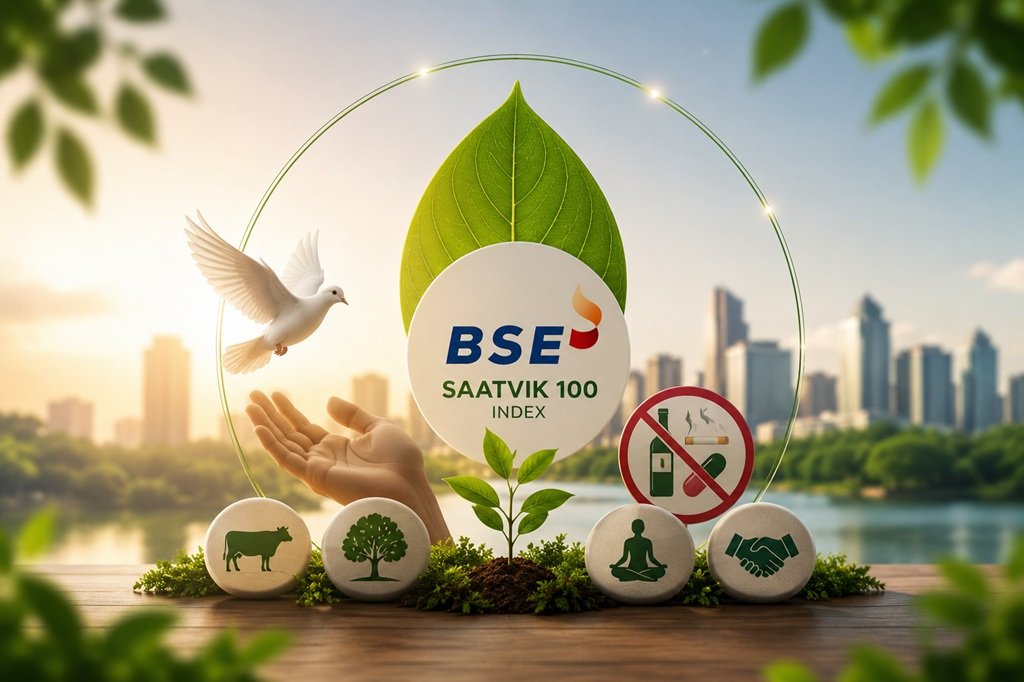
Why BSE Saatvik 100 Index?
The Saatvik 100 Index of BSE is a result of two main factors that are prevailing now in the country:
- The emergence of Environmental, Social and Governance (ESG) investing in the country.
- The increasing interest of investors in value investing.
In this way, the BSE Saatvik 100 index offers a choice of responsible value investing. Introduction of the BSE Saatvik 100 Index offered the measuring tool that Indian ethical investing really needed.
How Saatvik 100 Index Created?
Here is the step by step process used for creating Saatvik 100 Index.
Step 1: BSE 500 as Base
This index does not simply include companies selected out of thin air. The universe is based on the BSE 500, which is one of the broadest indices in India. This provides the index with companies that already have market presence, liquidity, and proper governance structure.
Step 2: Saatvik Filter
Saatvik Filter is applied based on activity or business type. Companies from the following industries are totally disallowed –
- Manufacture, distribution or retailing of alcohol
- Tobacco, any form
- Gambling, casinos, lotteries, betting websites
- Vulgar entertainment, anything considered obscene
- Narcotics, illegal drugs and other substances
- Leather industry, due to direct killing of animals
- Meat/poultry, for processing or retailing
- Pesticides/Insecticides, environmental hazard and cruel practices against animals
- Animal cruelty, anything involved with it
Step 3: Selection of Top 100
From the companies that have been excluded for reasons mentioned above, the rest are sorted out, and the top 100 are selected by their free-float market capitalization and trading liquidity. Only companies that meet the required criteria are considered for inclusion in the index.
Step 4: Semi-annual Reconstitution of Index
During each semi-annual review, eligible companies must be part of the BSE 500 and should not belong to the excluded industry categories. From the eligible pool, the top 100 companies are selected based on their average total market capitalisation to form the BSE Saatvik 100 Index.
The index will undergo regular review and maintenance. During rebalancing, the top 80 companies based on six-month average total market capitalisation are selected first.
While existing constituents ranked between 81 and 120 are retained based on their ranking until the index reaches its target of 100 companies.
Which Stock is in BSE Saatvik 100 Index?
Although the Saatvik 100 Index has very high standards for selection, it contains many of India’s biggest and most reputable firms, demonstrating that financial success and ethical investment strategies can indeed co-exist.
The top companies included in the Saatvik List are –
- HDFC Bank Ltd.
- ICICI Bank Ltd.
- Reliance Industries Ltd.
- Bharti Airtel Ltd.
- Larsen & Toubro Ltd.
- Infosys Ltd.
- State Bank of India (SBI)
- Axis Bank Ltd.
- Bajaj Finance
- HCL Technologies
- BHEL
- Cipla
- Maruti Suzuki
- NTPC
The index shows a large cap tilt since it selects stocks on the basis of market capitalization from the BSE 500 index.
Financial Services and Consumer Discretionary companies dominate this index. Financial Services: 37.55% (Highest contributor)
Consumer Discretionary: Second largest sector exposure
Energy: Third largest sector exposure
Other sectors in this Index include Commodities, Industrials, Utilities, Telecom, Services, FMCG, and Healthcare.
Who should invest in the Saatvik 100 Index?
Anyone can invest in it. It doesn’t matter whether or not you’re vegetarian, or even whether or not you follow Saatvik philosophy strictly. However, this index would be particularly suited for:
Individual value-based investors who can earn returns by sticking to their morals and ethics. Have you ever felt bad knowing that your mutual fund investment might have been making money off tobacco and gambling businesses? This index has been made for you.
Jain and Hindu investors who feel very strongly about the philosophy of Ahimsa and nonviolence. Here, you will get to see the reflection of your beliefs in the mainstream financial instruments.
Socially aware young investors who care about the source of their money and its investments.
Fund management institutions and companies which want to introduce new and unique products based on philosophies to a particular segment of society.
Financial advisors who help out clients belonging to societies where there are specific restrictions in terms of diet and Saatvik lifestyle and cannot find the appropriate benchmarking instrument for portfolios.
Conclusion
The launch of the BSE Saatvik 100 index represents a huge leap forward in ethical investment in India, because it shows that it is possible to make money while adhering to one’s values. The BSE Saatvik 100 index offers an authentic benchmark for value investing, and it has shown strong performance over the long term.

