

When you sit down to buy or sell a stock, the very first decision you make is which type of order to place. Most beginners just tap “Buy” without thinking much about it. But experienced traders and investors know that the order type you choose can make a real difference — it affects the price you get, how fast your trade goes through, and how much risk you are taking.
This guide covers every major type of stock market order in simple language. We have expanded on the basics and added context, real-world scenarios, common mistakes, and practical tips so you can walk away knowing exactly which order to use and when.
Whether you are an absolute beginner who just opened a demat account, or someone with a few years of trading experience looking to sharpen your skills, this article has something useful for you.
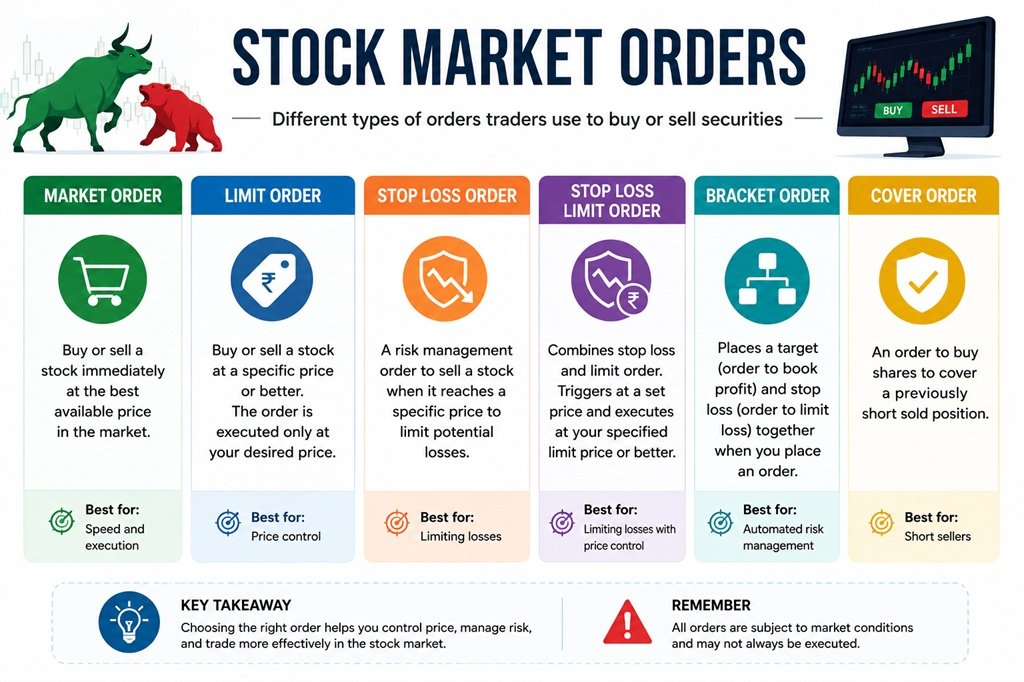
What is a Stock Market Order?
Think of a stock market order as a set of instructions you give to your broker. You are telling the broker: “Go to the exchange and buy (or sell) this stock for me, under these conditions.”
The conditions can be about price — for example, “only buy if the price drops to Rs. 500.” Or they can be about timing — “execute this trade only today.” Or they can be about both.
The exchange (NSE or BSE in India) receives your order, matches it with someone on the other side of the trade, and confirms the execution. This entire process can happen in milliseconds for some order types, or take days for others.
Understanding order types gives you much better control over your trades. Instead of just hoping you get a fair price, you can set rules in advance and let the system do the work.
Why Does Order Type Matter?
Here is a simple way to understand why order type matters. Imagine you want to buy 500 shares of a popular company. The stock is currently trading at Rs. 1,200.
- If you place a market order, you get the shares immediately but might end up paying Rs. 1,205 or even Rs. 1,210 if the market is moving fast.
- If you place a limit order at Rs. 1,195, you wait patiently and only buy if the price dips to that level — which may or may not happen.
- If you place a stop-loss order at Rs. 1,150 (after already owning the stock), you automatically sell if the price falls that far, protecting yourself from bigger losses.
Same stock. Very different outcomes. That is the power of choosing the right order type.
The Most Common Types of Stock Market Orders
1. Market Order
A market order is the simplest and most straightforward order type. When you place a market order, you are telling your broker: “Buy (or sell) this stock right now, at whatever the best available price is.”
The exchange fills your market order almost instantly, matching it with existing orders on the other side of the trade. Because speed is the priority here — not price — your actual execution price may differ slightly from the price you saw on screen when you placed the order. This difference is called slippage.
How a Market Order Works — Step by Step
Let us say shares of Infosys are trading at Rs. 1,800. You decide you want to buy 100 shares right now.
- You open your trading app and place a market buy order for 100 shares.
- Your order goes to the exchange within milliseconds.
- The exchange matches your order with sellers who are ready to sell.
- If there are enough sellers at Rs. 1,800 or close to it, your order gets filled.
- You now own 100 shares of Infosys.
If the stock is moving very fast or has low trading volume, you might get filled at Rs. 1,802 or even Rs. 1,808 instead of Rs. 1,800. That is normal slippage.
When to Use a Market Order
- When you are buying or selling a large-cap, highly liquid stock like Reliance, TCS, or HDFC Bank — where the bid-ask spread is very tight.
- When you absolutely must enter or exit a position right now, and price precision is less important than getting it done.
- When acting on news that just broke and you do not want to miss the move.
When NOT to Use a Market Order
- For small-cap or mid-cap stocks with low trading volume. Your order might move the price against you.
- When the market is very volatile and prices are swinging wildly.
- When you are placing a large order that could impact the price by itself.
2. Limit Order
A limit order lets you set the exact price at which you want to buy or sell. Unlike a market order, your order will only be executed at your specified price — or better.
This gives you complete control over the price you pay or receive. The trade-off is that your order may not get filled at all if the market never reaches your price.
Buy Limit Order
A buy limit order means: “Buy this stock only if the price falls to my specified level or below.”
Example: A stock is trading at Rs. 2,000. You think it might dip to Rs. 1,900 before bouncing back up. You place a buy limit order at Rs. 1,900. Your order sits in the order book and only executes if the price actually drops to Rs. 1,900 or lower. If the stock keeps rising, your order stays unexecuted and eventually gets cancelled.
Sell Limit Order
A sell limit order means: “Sell my shares only if the price rises to my specified level or above.”
Example: You bought a stock at Rs. 500. It is now at Rs. 620. You believe it will touch Rs. 700 before it peaks. You place a sell limit order at Rs. 700. If the price rises to Rs. 700 or higher, your shares get sold. If the price stays below Rs. 700, your shares stay in your demat account.
Advantages of a Limit Order
- You control the price completely.
- No risk of slippage — you will never pay more (for buys) or receive less (for sells) than your specified price.
- Great for patient investors who are not in a rush.
Disadvantages of a Limit Order
- The order might not get executed at all if the price never reaches your level.
- In a fast-moving market, you might miss a trade completely while waiting for your price.
- Partial fills can happen if there are not enough shares available at your exact price.
3. Stop Order (Stop-Loss Order)
A stop-loss order is one of the most important risk management tools available to traders. It is designed to limit your losses by automatically selling (or buying) a stock once it reaches a certain trigger price.
Here is the core idea: you set a “stop price.” When the market reaches that price, your stop order converts into a market order and gets executed immediately at the best available price.
Stop-Loss for Sellers (Most Common Use)
This is the most common use of a stop order. You already own a stock and want to protect yourself against a big fall.
Example: You bought 200 shares of a company at Rs. 1,000 per share. The stock is now at Rs. 1,050. Things are looking good, but you are nervous about a possible correction. You set a stop-loss at Rs. 950.
- If the stock keeps rising, your stop-loss just sits there doing nothing.
- If the stock starts falling and hits Rs. 950, your stop order triggers automatically.
- A market sell order is placed immediately.
- Your shares get sold at or near Rs. 950, limiting your loss.
Stop Order for Buyers (Breakout Trading)
Not many beginners know this, but a buy stop order is also possible. Traders use this when they want to buy a stock only if it breaks above a certain resistance level.
Example: A stock has been trading between Rs. 800 and Rs. 900 for months. You believe if it breaks above Rs. 900, it will start a new uptrend. You place a buy stop order at Rs. 905. If the stock breaks out above Rs. 900 and hits Rs. 905, your buy order triggers automatically.
The Important Limitation of Stop Orders
Once triggered, a stop order becomes a market order. This means in a fast-falling market, your actual execution price could be significantly lower than your stop price. This is called “gap risk” and it is a real issue during earnings announcements, news events, or market circuit breakers.
4. Stop-Limit Order
A stop-limit order combines a stop order and a limit order. It has two price levels instead of one.
- The stop price: This is the trigger. When the stock reaches this price, your order activates.
- The limit price: This is the minimum price at which you are willing to sell (or maximum price for a buy).
The key difference from a regular stop order: instead of converting to a market order when triggered, it converts to a limit order. This means you will not sell below your limit price, no matter what.
Detailed Example
You bought a stock at Rs. 2,000. You want to protect your downside but do not want to sell at a panic price.
- You set a stop price at Rs. 1,950.
- You set a limit price at Rs. 1,940.
- The stock falls from Rs. 2,000 to Rs. 1,980 to Rs. 1,960 to Rs. 1,950.
- When it hits Rs. 1,950, your stop triggers and a limit order is placed to sell at Rs. 1,940 or better.
- If there are buyers at Rs. 1,940 or above, your order executes.
- If the stock crashes straight through Rs. 1,940 with no buyers at that level, your order does NOT execute — and you stay in the trade.
When is a Stop-Limit Better Than a Stop-Loss?
Use a stop-limit when you want to avoid being sold out at an extremely low price during a flash crash or news-driven panic. However, remember the risk: your order might not execute at all, leaving you holding a stock that continues to fall.
5. Trailing Stop Order
A trailing stop order is one of the most elegant order types available. Unlike a regular stop order where the stop price is fixed, a trailing stop automatically moves in your favour as the price rises — but stays fixed if the price falls.
You set the trailing amount as either a fixed rupee amount or a percentage. The stop price is always calculated relative to the highest price the stock has reached since you placed the order.
How the Trailing Stop Moves
Let us walk through a detailed example to make this crystal clear.
- You buy a stock at Rs. 1,000.
- You set a 5% trailing stop. Your initial stop price is Rs. 950 (5% below Rs. 1,000).
- Stock rises to Rs. 1,050. Your stop automatically moves up to Rs. 997.50 (5% below Rs. 1,050).
- Stock rises to Rs. 1,100. Your stop moves to Rs. 1,045 (5% below Rs. 1,100).
- Stock rises to Rs. 1,150. Your stop moves to Rs. 1,092.50.
- Now the stock starts falling: Rs. 1,130… Rs. 1,100… Rs. 1,092.50.
- When the price hits Rs. 1,092.50, your trailing stop triggers and a sell order is placed.
- You exit with a profit of Rs. 92.50 per share, having captured a good chunk of the uptrend.
Why Trailing Stops Are Powerful
The beauty of a trailing stop is that it lets your profits run while still giving you protection. If a stock keeps going up, you keep riding it. But if it reverses by a meaningful amount, you get out automatically. You do not have to monitor the screen all day.
Ideal Situations for Trailing Stops
- Momentum stocks that are trending strongly upward.
- When you want to be in a trade for a while but want automatic protection.
- When you are going away on vacation and cannot monitor your positions.
- For swing traders who hold positions for a few days to a few weeks.
6. Intraday Order — Margin Intraday Square-off (MIS)
An intraday order, often called MIS (Margin Intraday Square-off) on Indian platforms, is an order placed with the intention of buying AND selling the same stock within the same trading day.
By default, all MIS positions must be closed before the market ends at 3:30 PM. If you do not close them yourself, your broker automatically squares them off — usually around 3:15 PM — regardless of profit or loss.
How Intraday Trading Works
The whole idea is to profit from small price movements that happen during the day. You buy a stock in the morning and sell it in the afternoon (or vice versa — you can even short sell first and buy later in intraday).
Example: You believe Tata Motors will rise today based on an auto sector report released in the morning. At 9:30 AM, you buy 1,000 shares at Rs. 450 using MIS. By 12:00 PM, the stock has moved to Rs. 462. You sell all 1,000 shares, booking a profit of Rs. 12 per share, or Rs. 12,000 in total — all in a single morning.
Leverage in Intraday Trading
One major advantage of MIS orders is that brokers offer extra leverage — meaning you can control a larger position with a smaller amount of money. If your broker offers 5x leverage, you can buy Rs. 1 lakh worth of shares with just Rs. 20,000 in your account.
However, leverage is a double-edged sword. While it amplifies profits, it also amplifies losses equally. A 2% move against you can wipe out 10% of your capital with 5x leverage.
Key Rules of Intraday Trading
- All positions must be squared off before 3:15-3:20 PM (varies by broker).
- If you forget, the broker auto-squares off your positions, sometimes at unfavourable prices.
- Intraday trading is best suited for experienced traders who understand technical analysis.
- Never risk money you cannot afford to lose in intraday trades.
7. Delivery Order — Cash and Carry (CNC)
A delivery order (also called CNC — Cash and Carry) is used when you want to buy shares and actually hold them in your demat account for the long term. This is the order type that long-term investors and those building a portfolio use the most.
When you buy shares using CNC, the shares get credited to your demat account after T+1 settlement (one trading day after the trade date). You can then hold these shares for days, months, or even years, and sell whenever you choose.
Why CNC is the Default for Investors
- No automatic square-off. Your shares stay in your account until you decide to sell.
- You receive all shareholder benefits: dividends, bonus shares, rights issues, and voting rights.
- No leverage, which means no risk of margin calls.
- Perfect for systematic investment plans and goal-based investing.
CNC trades require full payment upfront. If you want to buy Rs. 50,000 worth of shares, you need Rs. 50,000 in your trading account. There is no leverage.
Advanced Order Types
Beyond the basics, some brokers in India offer advanced order types that give traders extra tools for managing risk and automating their strategies.
Cover Order (CO)
A Cover Order is a special intraday order that requires you to set a compulsory stop-loss at the time of placing the order. You cannot place a cover order without specifying a stop-loss — it is built in.
Because the risk is automatically capped by the built-in stop-loss, brokers consider cover orders safer and typically offer higher leverage on them compared to regular MIS orders.
How a Cover Order Works
- You place a buy order at the current market price.
- Simultaneously, you must set a stop-loss price below the current price.
- Your position is open between the buy price and the stop-loss price.
- If the stock falls to your stop-loss, your position is automatically squared off.
- You must square off the position by end of day if the stop-loss is not triggered.
Cover orders are great for disciplined intraday traders who always want a defined risk level before entering any trade.
Bracket Order (BO)
A Bracket Order is like cover order’s big brother. Instead of just setting a stop-loss, you set three things at once:
- Entry Order: The price at which your trade starts.
- Target Order: The profit level at which you want to exit with gains.
- Stop-Loss Order: The price at which you exit to limit losses.
Once your entry order is executed, both the target and stop-loss orders become active simultaneously. Whichever one gets triggered first is executed, and the other is automatically cancelled.
Bracket Order Example
A stock is trading at Rs. 500.
- Entry: Buy at Rs. 500 (market order).
- Target: Sell at Rs. 520 (to book profit).
- Stop-Loss: Sell at Rs. 488 (to limit loss).
Now two scenarios can play out. If the stock rises to Rs. 520, your target order executes and you book Rs. 20 per share profit. The stop-loss at Rs. 488 is cancelled. If instead the stock falls to Rs. 488, your stop-loss triggers and limits your loss to Rs. 12 per share. The target at Rs. 520 is cancelled.
Bracket orders are excellent for traders who want a clear risk-reward setup on every single trade.
Order Validity — How Long Does Your Order Stay Active?
When you place a limit order or stop order, an important question arises: how long does that order stay in the system waiting to be filled? This is called order validity or time-in-force.
Day Order
A day order is valid only for the current trading session. If the order does not get executed during market hours, it is automatically cancelled when the market closes at 3:30 PM.
This is the default validity for most orders on Indian trading platforms. It keeps your order book clean — you are not left with old, outdated orders sitting around.
Example: You place a limit order to buy a stock at Rs. 480, but the stock never dips below Rs. 490 during the day. At 3:30 PM, your order is automatically cancelled. If you still want to buy at Rs. 480 tomorrow, you need to place a new order.
Immediate or Cancel (IOC) Order
An IOC order demands immediate execution — right now, this second. Any part of the order that cannot be filled instantly is cancelled on the spot.
Partial fills are allowed. If you want to buy 500 shares and only 300 are available at your price, those 300 get filled immediately and the remaining 200 is cancelled right away.
IOC orders are mostly used by institutional investors and high-frequency traders who need speed above all else. They are also useful when you want to buy at a specific price but only if the liquidity is available right now — not later.
Good Till Triggered (GTT) / Good Till Cancelled (GTC) Order
This is one of the most useful order types for patient investors. A GTT or GTC order stays active until the stock reaches your trigger price — even if it takes weeks or months.
In India, Zerodha, Groww, and several other platforms offer GTT orders. The way it works is that you set two prices: a trigger price and a limit price. When the stock reaches the trigger price, a limit order is automatically placed at your limit price.
Detailed Example of a GTT Order
A stock you have been watching is trading at Rs. 1,200. Based on your analysis, you think it is a good buy if it comes down to Rs. 1,000. But you do not want to sit watching the screen every day.
- You set a GTT with a trigger price of Rs. 1,000 and a limit price of Rs. 995.
- The GTT order sits quietly in your account.
- Weeks later, the stock dips to Rs. 1,000 after a market correction.
- Your GTT triggers and a limit buy order at Rs. 995 is automatically placed.
- If the price reaches Rs. 995, your order gets filled — even though you were not watching at all.
Why GTT Orders Are Useful for Investors
- You can pre-program your buying and selling levels well in advance.
- No need to monitor the market daily.
- Helps avoid emotional decision-making in the heat of the moment.
- GTT orders can remain active for up to a year on most platforms.
After Market Order (AMO)
An After Market Order is an order placed outside regular market hours — usually between 3:45 PM and 8:57 AM the next trading day. The order is placed in advance and executed when the market opens the next morning.
AMO orders are processed as market orders or limit orders at the start of the next trading session. They are great for people who cannot monitor the market during trading hours because they are at work or school.
The risk with AMO orders is that overnight news might cause the stock to open very differently from where it closed. Your AMO might execute at a significantly different price than you expected.
Market Order vs Limit Order
This is probably the most common question beginners have, so let us spend some extra time on it.
| Feature | Market Order | Limit Order |
| Execution Speed | Immediate | Only when price is reached |
| Price Certainty | No — depends on market | Yes — your price or better |
| Risk of Slippage | High (especially in volatile markets) | None |
| Risk of Not Executing | Very low | High (price may never be reached) |
| Best Used For | Highly liquid stocks, urgent trades | Specific price targets, patient traders |
| Complexity | Very simple | Simple, with one extra step |
| Good For Beginners? | Yes, for liquid stocks | Yes, once you understand price levels |
The honest answer is: both order types have their place. If you are buying Reliance or HDFC Bank, a market order is perfectly fine most of the time. If you are buying a mid-cap stock or you have a very specific entry price in mind, use a limit order.
Risks of Choosing the Wrong Order Type
Many traders — especially beginners — either do not know about all order types or do not bother thinking about which one is right for the situation. This leads to predictable problems.
Slippage from Market Orders
If you place a large market order for a stock with low daily volume, your order can actually move the price against you. You start buying at Rs. 200, but by the time your entire order is filled, the last shares are bought at Rs. 210. This is especially common in small-cap stocks.
Missing Trades with Limit Orders
Limit orders require patience. If you set your buy price too low, the stock may never reach it — especially in a bull market. You end up sitting on the sidelines watching a stock you wanted to buy go up 20% without you.
Non-Execution of Stop-Limit Orders
In a fast-falling market — for example, after a very bad earnings announcement — a stock might gap down by 10-15% at the open. If you had a stop-limit order, the stop triggers but the price might be so far below your limit that your order never executes. You are stuck holding a stock that has already dropped sharply.
Auto Square-Off Losses in Intraday
If you forget to close your MIS position and the broker auto-squares it off near market close, they may sell at a bad time or bad price. And if you have used leverage and the trade went against you, the auto square-off can result in a significant loss.
Emotional Decisions Without Orders
Not using stop-losses at all — which many beginners do — is perhaps the biggest risk of all. Without any protection, a stock that drops 20%, 30%, or even 50% can wipe out a large portion of your portfolio. Having automatic stop orders removes the temptation to “hold on a little longer” in the hope of recovery.
Practical Tips for Using Stock Market Orders
For Beginners
- Start with delivery (CNC) orders until you are comfortable with how the market works.
- For buying blue-chip stocks, market orders are fine. For everything else, use limit orders.
- Always set a stop-loss, even if you are investing for the long term. At least mentally decide the price at which you would re-evaluate your thesis.
- Do not experiment with intraday trading (MIS) until you have at least six to twelve months of experience and understand technical analysis.
- Use GTT orders if you have a wishlist of stocks you want to buy on dips.
For Intermediate Traders
- Learn to use stop-limit orders to protect yourself during volatile news events.
- Practise with trailing stops to capture trends without constant monitoring.
- Explore bracket orders for a more structured approach to intraday trades.
- Review your order history regularly to see which order types served you well and which did not.
General Best Practices for All Investors
- Always double-check your order before submitting: quantity, order type, and price.
- Be careful with market orders in the first 15 minutes of the market opening (9:15 AM to 9:30 AM) when volatility is highest.
- Never place a large market order for an illiquid stock — always use limit orders.
- Keep a trading journal. Note which order types you used and what the outcome was.
- Understand the brokerage implications of different order types — some advanced orders might have different fee structures.
Final Thoughts
Stock market orders might seem like a small detail, but they have a surprisingly big impact on your trading results over time. Getting into a good stock at the wrong price, or failing to protect a position with a stop-loss, can make the difference between a profitable year and a difficult one.
The good news is that understanding order types is not that complicated once you break it down. You do not need to memorise all of them at once. Start with market orders and limit orders. Once you are comfortable, add stop-losses to your toolkit. Then gradually explore trailing stops, GTT orders, and bracket orders as your experience grows.
Remember: the stock market rewards discipline and preparation. Knowing exactly how you will enter and exit a trade — and which order types you will use — is part of being a disciplined, prepared investor.
Take your time, practise with small amounts, and always know your risk before placing any trade.

