

Let’s be honest — when you first moved abroad and someone back home mentioned “NRI accounts,” your eyes probably glazed over. Three confusing acronyms, a dozen rules, and a handful of bank brochures that somehow managed to explain nothing clearly. Sound familiar?
Well, you’re not alone. Thousands of Non-Resident Indians wrestle with this exact question every year: between FCNR NRE NRO accounts, which one’s actually the right fit for their money? Whether you’re sending remittances home, parking your foreign salary somewhere safe, or just trying to keep your savings from getting eaten up by taxes and currency swings — the answer genuinely matters.
Here’s the thing, though. It’s not as complicated as the banking jargon makes it sound. Once you strip away the finance-speak and look at what each account actually does, the choice becomes surprisingly straightforward. This guide does exactly that. We’ll walk through each account type — what it is, who it’s for, what it costs, and where it shines — so you can walk away with a real answer, not just more confusion.
What Are NRI Bank Accounts?
Before diving into the FCNR NRE NRO comparison, it helps to understand why these accounts exist in the first place. When an Indian citizen becomes a Non-Resident Indian — either by taking up employment abroad, getting a foreign visa, or simply living outside India for more than 182 days in a financial year — their residential status changes under the Foreign Exchange Management Act (FEMA).
That change in status means they can no longer simply use a regular Indian savings account. The Reserve Bank of India (RBI) has laid out specific account types to help NRIs manage money both in India and abroad. Each type serves a different purpose, and mixing them up can lead to tax complications, repatriation issues, or just plain missed opportunities.
So the three key players are:
- NRE Account — Non-Resident External Account
- NRO Account — Non-Resident Ordinary Account
- FCNR(B) Account — Foreign Currency Non-Resident (Banks) Account
They’re all legitimate, RBI-approved, and widely offered by Indian banks. But they work very differently — and that’s where most people get tripped up.
What Is an NRE Account?
An NRE account is essentially your go-to if you want to park your foreign earnings in India. You deposit money in a foreign currency (say, US dollars or British pounds), the bank converts it to Indian rupees, and you hold it in an INR-denominated account.
The big draw? Everything in an NRE account is completely tax-free in India. Interest earned, principal, the whole lot — you don’t owe a single rupee in Indian income tax on it. That’s a pretty sweet deal, honestly.
On top of that, both the principal and interest are fully repatriable. In plain English, that means you can move your money back out of India to your country of residence without any fuss or RBI permission needed.
Who Should Open an NRE Account?
If you’re earning abroad and want to save in India while keeping the option to bring that money back whenever you need it — an NRE account is your best bet. It’s particularly popular among:
- Software engineers working in the US or UK
- NRIs sending regular remittances to family in India
- People planning to return to India eventually but not immediately
- Anyone who wants to invest in Indian mutual funds or stocks using foreign income
The Catch With NRE Accounts
The conversion from foreign currency to rupees happens at the time of deposit. That means you’re exposed to currency exchange risk. If the rupee weakens significantly, great — your money is worth more. But if it strengthens, you could lose a bit on the conversion. It cuts both ways.
What Is an NRO Account?
Here’s where it gets a little different. An NRO account is designed for income that originates in India. Think rental income from a property in Bengaluru, dividends from Indian shares, a pension from a government job, or proceeds from selling a piece of land back home.
Unlike the NRE account, funds in an NRO account are held in Indian rupees and are subject to Indian income tax. Interest earned on an NRO account is taxable at 30% (plus applicable surcharge and cess), which is admittedly steep. Banks also deduct TDS — Tax Deducted at Source — on the interest before you even see it.
Repatriation Rules for NRO Accounts
This is where NRO accounts get a bit tricky. Repatriation — that is, moving money from your NRO account back to a foreign bank account — is allowed, but with limits. As of current RBI guidelines, you can repatriate up to USD 1 million per financial year from an NRO account, provided you’ve paid all applicable taxes and submit a CA certificate (Form 15CA/15CB).
So it’s not impossible, but it does require more paperwork compared to an NRE account.
Who Should Open an NRO Account?
If you have any income coming in from India — rental income, interest, dividends, business income — you essentially need an NRO account. It’s not really optional for most NRIs with financial ties back home. In fact, many NRIs end up converting their existing Indian savings accounts into NRO accounts once their residential status changes, which is exactly what FEMA requires.
What Is an FCNR(B) Account?
FCNR stands for Foreign Currency Non-Resident (Banks). Unlike the NRE and NRO accounts, an FCNR(B) account holds your money in foreign currency itself — no conversion to rupees. You can open FCNR(B) accounts in several permitted currencies, including:
- US Dollar (USD)
- British Pound (GBP)
- Euro (EUR)
- Japanese Yen (JPY)
- Canadian Dollar (CAD)
- Australian Dollar (AUD)
It’s a fixed deposit — not a savings account — so you deposit money for a fixed tenure ranging from 1 year to 5 years and earn interest in the same foreign currency. When it matures, you get your principal and interest back in the same currency you deposited.
Why Is the FCNR(B) Account So Underrated?
Because it completely eliminates currency risk. That’s huge. A lot of NRIs are hesitant to bring money to India precisely because they’re worried about what happens to the rupee. With an FCNR(B) account, that concern just… disappears. Your money stays in dollars, pounds, or euros the whole time.
Interest earned on FCNR(B) accounts is also fully exempt from Indian income tax, just like an NRE account. And the funds are fully repatriable — again, just like NRE. So in many ways, FCNR(B) is the NRE account’s more stable, currency-protected sibling.
The Limitations of FCNR(B)
It’s a term deposit, not a regular savings account. You can’t dip into it freely like you might with an NRE savings account. Also, interest rates on FCNR(B) accounts depend on international benchmarks (like LIBOR or SOFR), and they’ve historically been lower than NRE fixed deposit rates. That said, when the rupee is volatile, the currency protection can more than make up for the lower interest rate.
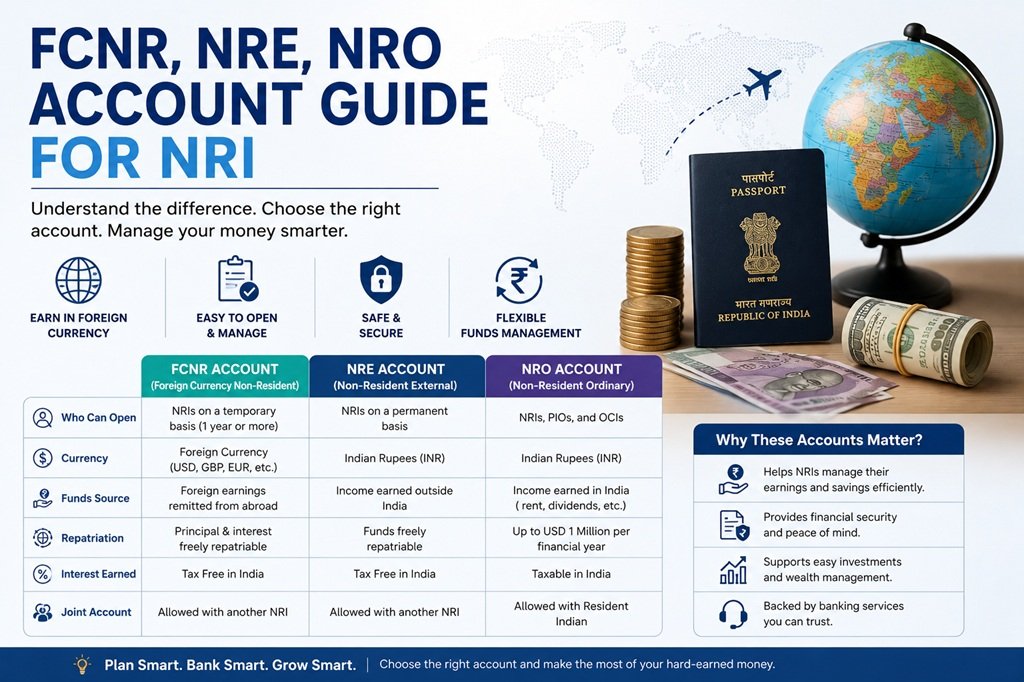
FCNR NRE NRO Comparison
Here’s the clear, no-nonsense comparison table:
| Feature | NRE Account | NRO Account | FCNR(B) Account |
| Currency | Indian Rupees (INR) | Indian Rupees (INR) | Foreign Currency |
| Account Type | Savings/FD/Current | Savings/FD/Current | Fixed Deposit only |
| Source of Funds | Foreign income only | Indian income | Foreign income only |
| Taxability in India | Tax-free | Taxable (30% TDS on interest) | Tax-free |
| Repatriation | Fully repatriable | Up to USD 1 million/year | Fully repatriable |
| Currency Risk | Yes (converts to INR) | Yes (already INR) | No (stays in foreign currency) |
| Joint Account | With another NRI | With NRI or resident Indian | With another NRI |
| Tenure (FD) | 7 days to 10 years | 7 days to 10 years | 1 year to 5 years |
That one table right there probably answers half your questions, doesn’t it?
FCNR NRE NRO and Tax
NRE Tax Benefits
The NRE account’s tax exemption is one of its strongest selling points. Interest earned — whether on savings or fixed deposits — is entirely outside the scope of Indian income tax. This makes it especially attractive for NRIs in high-tax countries who are already paying taxes abroad and don’t want to deal with double taxation in India.
That said, it’s worth checking your country of residence’s tax laws. Some countries, like the US, tax global income — so even though India won’t tax your NRE interest, the IRS might.
NRO Tax Reality
The 30% TDS on NRO interest stings a little, there’s no sugarcoating it. However, India has Double Taxation Avoidance Agreements (DTAA) with many countries. If your country has a DTAA with India, you might be able to claim credit for the taxes paid in India or benefit from a reduced TDS rate. This requires submitting your Tax Residency Certificate (TRC) to your bank, but the effort can be well worth it.
FCNR(B) Tax Treatment
Same as NRE — completely exempt from Indian income tax. Since the account is in foreign currency, there’s also no capital gains angle when you repatriate. Clean, simple, and tax-efficient.
Common Mistakes NRIs Make With FCNR NRE NRO Accounts
Let’s talk about the slip-ups people regularly make. Awareness is half the battle!
- Continuing to use a regular Indian savings account after becoming an NRI. This is actually a FEMA violation. Once you become an NRI, you’re required to convert your existing savings account to an NRO account or close it.
- Assuming NRO and NRE are interchangeable. They’re not — depositing foreign income into an NRO account is technically allowed, but you lose the tax exemption and full repatriation benefits you’d get with an NRE account.
- Ignoring FCNR(B) altogether. Many NRIs don’t even know it exists. It’s not marketed as aggressively by banks, but for someone with significant savings in foreign currency, it’s genuinely the most protective option.
- Not submitting DTAA documents. If your country has a treaty with India and you’re getting taxed at 30% on your NRO interest without submitting a TRC, you’re possibly overpaying. Get that paperwork sorted.
- Opening accounts in the wrong name. NRE and FCNR(B) accounts can only have joint holders who are NRIs. An NRO account can have a resident Indian as a joint holder. Many people get this wrong when trying to add a parent or spouse as a joint holder.
Frequently Asked Questions
Can I have all three accounts simultaneously?
Absolutely, yes! In fact, many NRIs do exactly that. Each account serves a distinct purpose, and holding all three lets you cover every financial base — foreign savings, Indian income, and currency-protected deposits.
Can I transfer money from NRO to NRE?
Yes, you can transfer up to USD 1 million per financial year from your NRO to your NRE account, subject to tax compliance and submission of Form 15CA/15CB signed off by a Chartered Accountant. It’s not instant, but it’s doable.
What happens to my FCNR NRE NRO accounts if I return to India permanently?
Once you return to India and your residential status changes back to “Resident,” you’ll need to re-designate your accounts. NRE and FCNR(B) accounts convert to resident rupee accounts or RFC (Resident Foreign Currency) accounts. NRO accounts simply become regular savings accounts.
Which account offers the best interest rates?
NRE fixed deposits tend to offer some of the highest interest rates in India — sometimes comparable to regular domestic FDs. FCNR(B) rates are tied to international benchmarks and are generally lower in absolute terms. NRO rates are similar to NRE rates, but the tax deduction eats into your effective yield. So if you’re purely chasing returns, NRE FDs often win — but always weigh the currency risk.
Is TDS deducted automatically on NRE accounts?
Nope! Since NRE accounts are tax-exempt, no TDS is deducted. On NRO accounts, TDS at 30% (plus surcharge and cess) is deducted automatically by the bank. You’ll need to claim refunds or credits separately if DTAA applies.
Can an NRI gift money to a resident Indian through these accounts?
Yes. Funds from NRE and FCNR(B) accounts can be gifted to a resident close relative, subject to LRS (Liberalised Remittance Scheme) limits. NRO accounts can also be used for gifting within applicable RBI guidelines.
The Bottom Line on FCNR NRE NRO Accounts
Here’s the honest summary: there’s no single “best” account in the FCNR NRE NRO trio. Each one was built for a specific situation, and the smartest NRIs don’t choose between them — they use them strategically together.
If you’ve got Indian income rolling in, the NRO account isn’t optional — it’s essential. If you’re parking foreign earnings in India and want tax-free, fully repatriable savings, the NRE account is your workhorse. And if you’re sitting on a chunk of foreign currency and don’t want the rupee’s ups and downs keeping you up at night, the FCNR(B) account is genuinely one of the most underappreciated financial tools available to NRIs.
The key takeaway? Don’t let the jargon scare you off from making active decisions about your money. You’ve worked hard for it — whether in Sunnyvale or Singapore or Sheffield — and it deserves a smarter home than a neglected savings account that no longer fits your life.
Talk to a qualified NRI tax advisor, compare rates across a couple of banks, and get your accounts set up properly. Future-you, sitting comfortably with your finances sorted, will be very glad you did.
Conclusion
Navigating the world of FCNR NRE NRO accounts can feel overwhelming at first glance, but once you understand what each one actually does, it’s really just a matter of matching the account to your money’s origin and purpose. NRE for tax-free foreign earnings in rupees. NRO for Indian-sourced income. FCNR(B) for foreign currency savings that you’d rather not convert just yet.
Most NRIs will find they need more than one — and that’s perfectly fine. The Indian banking system has designed these accounts to work together, covering different corners of an NRI’s financial life. The real mistake is doing nothing and leaving your money in the wrong place — or worse, in a regular savings account that’s technically non-compliant.
So take the first step today. Review your income sources, weigh your repatriation needs, consider your tax situation, and open the account that actually suits your life abroad. Your savings deserve nothing less.

