

You have invested in five different mutual funds. You feel confident that your money is well spread out and that you are not putting all your eggs in one basket. But what if I told you that all five of those funds might actually be holding many of the same companies? That is the problem of mutual fund portfolio overlap — and it is far more common than most investors realise.
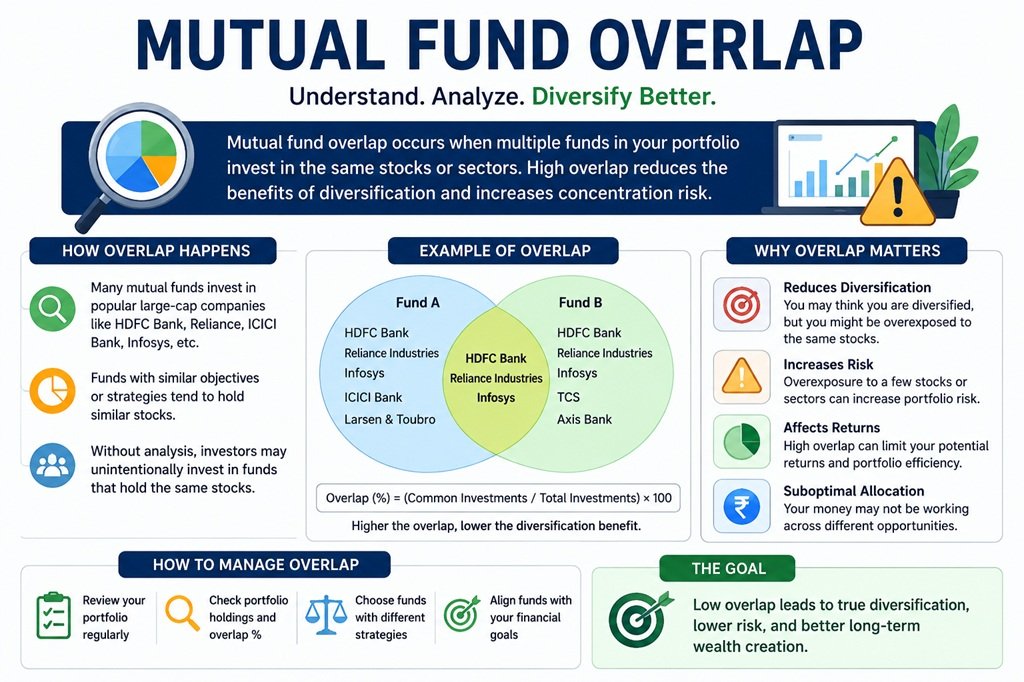
What Is Mutual Fund Overlap?
When you invest in more than one mutual fund, each fund holds a collection of stocks or bonds. Portfolio overlap happens when two or more of your funds are holding the same stocks or securities.
Think of it this way. Imagine you buy apples from two different shops, believing you are getting variety. But when you get home, both bags are full of the same type of apple — Red Delicious from the same farm. You paid for two bags thinking you had variety, but you really just bought the same thing twice.
That is exactly what mutual fund overlap feels like. Your portfolio might look diversified on the surface — you have a large-cap fund, a flexi-cap fund, and a blue-chip fund — but all three might have Reliance Industries, HDFC Bank, Infosys, and TCS among their top holdings. In that case, you are not as diversified as you think. This is often called false diversification.
This is not just a minor inconvenience. It is a real problem that can silently affect your returns and expose you to more risk than you signed up for.
A Real-World Example to Make It Clear
Let’s say you invest in three different equity mutual funds:
- Fund A: A large-cap fund
- Fund B: A Nifty 50 index fund
- Fund C: A flexi-cap fund
Now, the Nifty 50 index fund by definition holds all 50 companies in the Nifty 50 index. Large-cap funds are also required by SEBI (the market regulator) to invest at least 80% of their money in the top 100 companies by market cap. Flexi-cap funds have the freedom to invest anywhere, but most fund managers tend to lean heavily on the same large, reliable companies.
The result? There is a good chance that all three funds have significant overlap in the top 10 holdings. You might think you are diversified across three funds, but a large portion of your money is essentially riding on the same handful of large-cap stocks.
Why Does Portfolio Overlap Happen?
Understanding why this happens can help you avoid it going forward. Here are the most common reasons:
- Investing in multiple funds of the same category
If you invest in two large-cap funds, or two mid-cap funds, they are almost certain to have similar holdings. SEBI’s categorisation rules mean that funds in the same category must invest in similar types of stocks. Two large-cap funds will both have to pick from the same pool of companies.
- Chasing well-performing, popular companies
Fund managers across different funds all tend to favour the same tried-and-tested companies — the blue-chip giants that have a strong track record. This means that even funds from different categories can end up holding the same high-quality stocks like HDFC Bank, Infosys, or Asian Paints.
- Sector-focused investing
If you invest in a technology sector fund and a growth-oriented equity fund, both may end up holding the same major IT companies, leading to overlap within that sector.
- Combining index funds with active funds
An index fund that tracks Nifty 50 and an actively managed large-cap fund are likely to have many of the same stocks, since the active fund manager also benchmarks against the same index.
- Not researching before investing
Many investors choose funds based on ratings, past performance, or a friend’s recommendation — without actually looking at what the fund holds. This is one of the most common causes of unintentional overlap.
Why Does Overlap Matter?
Portfolio overlap might seem harmless on paper, but it has a few serious consequences that every investor should understand.
- You Are Not Actually Diversified
The biggest benefit of owning multiple mutual funds is supposed to be diversification — spreading your risk so that a fall in one stock or sector doesn’t drag down your whole portfolio. But if your funds are all holding the same stocks, a crash in those stocks will hit all your funds at the same time. You have paid for diversification but have not actually achieved it.
- Losses Get Multiplied
When an overlapping stock falls — let’s say HDFC Bank drops by 15% — and that stock is present in three of your funds, the negative impact on your portfolio is effectively tripled. Instead of the loss being contained to one fund, it spreads across multiple funds simultaneously.
- You Are Paying More Fees for No Extra Benefit
Every mutual fund charges a fee, called the expense ratio, to manage your money. If two funds are essentially holding the same stocks, you are paying two sets of management fees for what is essentially the same portfolio. Over time, these extra costs chip away at your returns.
- You Miss Out on Better Opportunities
The money parked in overlapping funds could have been deployed in genuinely different asset classes, sectors, or geographies. By concentrating too much in overlapping funds, you miss out on the growth that other parts of the market might offer.
- Your Risk Assessment Becomes Inaccurate
When you review your portfolio, you might think your concentration in any one stock is small. But if that stock appears across four different funds, your actual exposure to it is much higher than you realise. This makes it very hard to truly understand the risk level of your portfolio.
How to Detect Mutual Fund Overlap
The good news is that portfolio overlap is completely detectable — you just need to know where to look and what to check.
Method 1: Use the Simple Overlap Formula
There is a straightforward way to calculate the overlap between two funds:
Overlap % = (Number of stocks common to both funds) ÷ (Total unique stocks across both funds) × 100
For example, if Fund A holds 40 stocks and Fund B holds 45 stocks, and 20 of those stocks appear in both funds, then:
- Total unique stocks = 40 + 45 – 20 = 65
- Overlap = 20 ÷ 65 × 100 = 30.8%
A higher overlap percentage means less real diversification. As a rough guide:
- Below 15%: Healthy — your funds are genuinely diversified
- 15%–30%: Moderate — monitor this and see if it can be improved
- Above 30%: High — you likely have a false diversification problem worth addressing
Method 2: Manually Compare Fund Factsheets
Every mutual fund in India is required to publish its complete portfolio holdings every month. You can find these factsheets on the fund house’s website or on platforms like Valueresearchonline, Morningstar India, or Moneycontrol. Download the holdings of each fund in your portfolio and look for stocks that appear in more than one fund.
Pay special attention to the top 10–15 holdings of each fund, since these make up the bulk of a fund’s portfolio and have the most impact on performance.
Method 3: Check Fund Categories
Before investing, or when reviewing your portfolio, simply look at what category each fund falls into. If two or more funds belong to the same category (e.g., two large-cap funds or two flexi-cap funds), there is a strong chance of overlap. SEBI’s fund categorisation system makes this easy to check.
Method 4: Look for Similar Performance Patterns
If you notice that two funds in your portfolio always seem to rise and fall together — performing almost identically in all market conditions — that is a strong signal that they hold similar stocks. True diversification should mean that different funds in your portfolio respond differently to market events.
Method 5: Use Online Overlap Checking Tools
Several free online tools now let you compare mutual fund portfolios for overlap. Websites like Valueresearchonline, Kuvera, and Groww offer features where you enter the names of your funds and instantly see the percentage of overlapping holdings. These tools save a lot of time and are very easy to use.
Method 6: Do a Full Portfolio Review
If you want the most thorough picture, compile the complete holdings of all your funds into one spreadsheet and highlight any stock that appears in more than one fund. Count how many funds each stock appears in and what percentage of your total invested amount is exposed to that single company. This gives you a very clear picture of your true concentration.
Method 7: Consult a Financial Advisor
If you find this process confusing or time-consuming, a SEBI-registered investment advisor can do this analysis for you. They use professional tools and bring experience to the table, so they can not only detect overlap but also suggest a restructured portfolio tailored to your specific financial goals.
How Much Overlap Is Acceptable?
There is no universally agreed-upon “safe” number, but here is a practical guideline. If two funds share more than 40–50% of their holdings, you are essentially duplicating your investment. In most cases, keeping the overlap between any two funds below 25–30% is a reasonable target for retail investors.
It is also worth noting that some degree of overlap is almost unavoidable if you invest in Indian equity funds, because the Indian market has a limited number of high-quality, highly liquid companies. The same names will appear across categories. The goal is not zero overlap, but manageable overlap.
How to Avoid or Fix Mutual Fund Overlap
Now that you know how to detect overlap, let’s talk about what you can actually do about it.
- Invest Across Different Categories
The single most effective way to avoid overlap is to make sure your funds belong to genuinely different categories. Instead of having two large-cap funds, consider having one large-cap fund, one mid-cap fund, and one small-cap or sector fund. Or combine equity funds with a debt fund or international equity fund. The more distinct the categories, the lower the natural overlap.
- Check Top Holdings Before You Invest
Before adding any new fund to your portfolio, take five minutes to look at its top 10 holdings. Compare them with the funds you already own. If you see a lot of familiar names, that is a red flag. Move on to a fund whose top holdings look different from what you already have.
- Choose Funds with Different Investment Styles
Fund managers have different styles — some are “growth” investors (buying companies with high growth potential), while others are “value” investors (buying companies that appear undervalued). Mixing these styles naturally reduces overlap, because growth and value fund managers often don’t buy the same stocks.
Similarly, combining an actively managed fund with a passively managed index fund can work well if the index fund tracks a different index — for example, combining a Nifty 50 index fund with a Nifty Next 50 index fund gives you exposure to the top 100 companies with very little overlap, since the two indexes track different sets of companies.
- Consider Different Benchmarks
Funds that follow different benchmarks are less likely to overlap. A fund benchmarked against the Nifty 50 and a fund benchmarked against the BSE Mid-Cap Index will naturally have very few stocks in common, simply because they are drawing from different universes of companies.
- Limit the Total Number of Funds
More funds does not mean more diversification. In fact, beyond a certain point, adding more funds actually increases the chances of overlap. Most financial experts agree that a well-structured portfolio of 4–6 funds is enough for most retail investors to achieve meaningful diversification across market caps, sectors, and asset classes. Beyond that, you are likely just adding complexity and cost without adding real diversification.
- Add Variety Across Asset Classes
Instead of adding a sixth or seventh equity fund, consider adding a debt fund, a gold fund, or an international fund to your portfolio. These have near-zero overlap with your equity holdings and genuinely diversify the risk in your portfolio.
- Rebalance Regularly
Markets change, and so do fund portfolios. A fund that had very little overlap with your other funds a year ago might have shifted its holdings since then. Make it a habit to review your portfolio at least once every six months. Check for any new areas of overlap that may have developed and rebalance if necessary.
Frequently Asked Questions
Q: Is some overlap normal?
Yes, especially in the Indian market. Because there are a limited number of high-quality, highly liquid stocks, some overlap across equity funds is almost unavoidable. The goal is to keep it at a manageable level — typically below 25–30% between any two funds.
Q: How often should I check for overlap?
At least twice a year, or whenever you are thinking of adding a new fund to your portfolio. Fund holdings can change as fund managers adjust their positions.
Q: If I have overlap, should I immediately sell one fund?
Not necessarily. Consider the tax implications of selling (especially if your investment has grown and you would have to pay capital gains tax), the exit load if you are selling within a certain period, and the overall quality of the fund. Sometimes it makes more sense to stop putting new money into the overlapping fund and let your newer contributions build a better-structured portfolio going forward.
Q: Does overlap affect debt funds too?
Yes, but it is less common and less impactful in debt funds, since there are many more bonds available and the overlap in bond holdings is typically smaller. That said, if you have two liquid funds or two short-duration funds, it is worth checking.
Conclusion
Portfolio overlap is one of the most overlooked problems in mutual fund investing. It quietly undermines the diversification you thought you had, exposes you to higher risk, and costs you money in fees — all without you realising it.
The fix is not complicated. It starts with awareness. Take an afternoon to look at the actual holdings of each fund in your portfolio. Compare them. Use the free tools available online. If you find significant overlap, make a plan to gradually restructure your portfolio into genuinely diversified funds that cover different categories, asset classes, and investment styles.
Remember: true diversification is about owning assets that behave differently from each other. When markets fall, you want some of your investments to be less affected. That cushion only works if your funds are genuinely holding different things.
Investing in multiple funds is a smart strategy — but only when those funds are truly different from each other. Make sure yours are.

