

Stock selection is time-consuming, and at times, you may not be certain about whether the decision was right. Artificial Intelligence provides a platform where you can accelerate the entire procedure. Be it information analysis, evaluation of your trade strategy, or selection of an effective portfolio, everything can be done with the assistance of AI.
While there are no guarantees whatsoever, artificial intelligence will make stock trading easier for you.
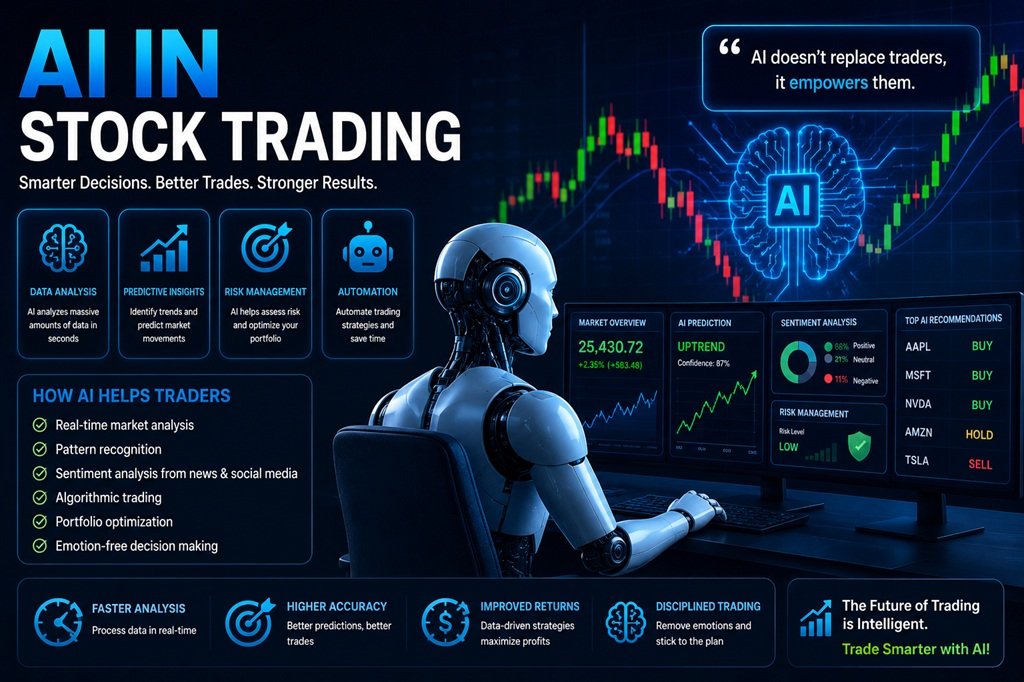
Application of AI tools in choosing stocks
One of the main applications of AI technologies in stock trading is stock picking. In case you are going to buy or trade particular stocks, AI tools will be useful for you as a stock picker. For instance, you can make use of an AI technology to look for growth stocks in a definite industry, firms with certain price-earnings (P/E) ratio values, or stocks by sentiment.
Additionally, AI tools will allow you to evaluate various data by taking into account not only its nature but also sentiment, historical patterns, and performance. This type of data will be analyzed automatically and the result of your evaluation will come out in just seconds, providing you with a list of options.
How to implement the use of AI in your trading strategy
AI programs can be used not only to determine which assets to trade but for other types of financial analyses and calculations as well, whether you trade actively or follow a passive investment strategy.
Custom indicators creation
Some stock exchange websites and applications offer the possibility of building unique charts with additional indicators. Using AI, you can create such indicators without any programming experience by setting specific parameters. For instance, you could tell the AI to color trading volume in bright orange if the number of traded stocks is double its value during the previous 30 days. Then you can integrate the code generated by the program into your trading platform to find such signals easily while assessing charts.
Historical data tests
To test the viability of a trading strategy, stock traders usually conduct a practice known as backtesting. Here, AI can help simplify the process and prioritize historical periods according to how closely they resemble the current state of the market. The tool may also offer options for scenarios, i.e., testing different assumptions regarding interest rates, inflation, and market volatility.
Asset Allocation Suggestions
AI algorithms can offer a specific investment portfolio consisting of stocks, bonds, and funds based on the risk profile and other preferences. For those who want to invest in index funds, some AI solutions will allow users to select suitable mutual funds or ETFs that correspond with their preferred asset allocation and offer re-balancing advice.
Performance Evaluation
Certain types of AI applications can create various performance metrics depending on the portfolio information or trade history entered by the user. For example, the system can analyze your risk/reward ratio, average profit per trade, win/loss ratio, and others.
AI-Fueled Investing Applications
There are plenty of stock trading and investing applications that leverage various AI tools in order to assist traders in selecting assets for their portfolios. Some examples of these AI-powered stock trading applications include AInvest, Magnifi, Streetbeat, Trade Ideas, and TrendSpider.
Advantages and disadvantages of AI trading stocks
While AI offers faster research and automation capabilities for trading, there is nothing perfect about it. Advantages and disadvantages of AI trading are listed below.
Advantages
Saves time on research – AI is capable of rapidly analyzing large volumes of information about market trends and providing useful conclusions, saving your time and effort to conduct research.
24×7 operation – Some AI applications are able to conduct trades automatically without your constant presence and intervention, even when you sleep or are not near a computer or phone.
More economical – There are AI-based applications that do not require expensive payments and are included into free apps or robo-advisors.
Disadvantages
Garbage in, garbage out – AI algorithms rely on inputs from company balance sheets, stock market feeds, and other external sources. If these inputs happen to be incomplete, outdated, or incorrect, the output will not be trustworthy enough to base trading decisions on.
Lack of judgment – AI can assist in minimizing emotional decision making, but it does not take the place of experience and instinct, particularly when dealing with unusual market conditions.
Security risks – Adopting an AI algorithm for trading purposes does not necessarily ensure that there will be no hacking attempts. Many such solutions might even gather sensitive information about your activity and make it available to third parties without fully disclosing their policies on data protection.
Risk factors that should be considered while trading using AI
Although technology may help traders, there is no sure way to ensure profits. Although some software can analyze markets and make suggestions, it might still end up in bad deals or investments which do not fit one’s profile. It is important to know how much risk one is willing to take regardless of the trading method.
AI software can make automatic transactions based on certain criteria that were set beforehand. This may sometimes be helpful, but at the same time, traders might find themselves buying stock they did not want to by default. Since automatic transactions can be made, it becomes necessary for people to understand what the criteria are if they decide to go for more complicated trading methods like options.
Data security may also become an issue, just as it is with other technologies.
Conclusion
Artificial intelligence is capable of aiding in several aspects of trading from stock screening and indicator construction through strategy testing and portfolio re-balancing. However, it is not a means for getting superior results easily and effortlessly since the outcome will depend greatly on the underlying information and principles involved, and you have to take responsibility for what you choose to do.
If you want to explore how AI could be used to improve your trading, begin with small steps and don’t believe any tall stories.

