

Investing in gold or silver used to mean buying physical jewellery, coins, or bars and then worrying about keeping them safe in a bank locker. Today, things are much simpler thanks to Gold ETFs and Silver ETFs. These are like mutual funds that let you own a piece of these precious metals without ever touching them physically.
Instead of dealing with purity checks, making charges, storage fees, or theft risks, you buy and sell units on the stock exchange just like shares. Many Indians are turning to these ETFs because they offer an easy, transparent, and low-hassle way to add precious metals to their investments. But if you’re confused between gold and silver ETFs, you’re not alone. Let’s break it down in simple terms so you can decide what fits your goals.
Why Are So Many Indians Choosing Precious Metal ETFs?
India has a long cultural love for gold and silver — think weddings, festivals like Akshaya Tritiya, and family traditions. But physical buying comes with headaches: high making charges (sometimes 10-20% extra), locker rent, insurance, and the fear of theft or loss.
ETFs solve these problems. The fund house buys and stores high-purity physical gold or silver in secure vaults. You own “units” that track the metal’s price. You can buy even small amounts, sell anytime during market hours, and enjoy better liquidity. In uncertain times — with inflation, rupee fluctuations, or global tensions — many see these as a safe way to protect their savings.
What Exactly is a Gold ETF?
A Gold ETF is an exchange-traded fund that invests in physical 24K gold bullion. Each unit you buy represents a certain amount of real gold stored safely by the fund. For example, some popular Gold ETFs have units linked to 1 gram of gold.
You don’t get the gold delivered to your home. Your profit (or loss) comes purely from changes in gold prices. These ETFs are passively managed, meaning they simply follow the gold price with very little active buying and selling inside the fund. This keeps costs low.
Real-life benefits of Gold ETFs:
- No storage or safety worries — the fund handles secure vaults.
- No making charges or wastage like in jewellery.
- High liquidity — you can buy or sell during stock market hours on NSE or BSE.
- Transparent pricing that closely tracks international and local gold rates.
- Acts as a classic “safe haven” during economic slowdowns, stock market crashes, or high inflation.
Many people use Gold ETFs for long-term wealth protection. If the economy feels shaky or the rupee weakens, gold prices often rise, helping preserve your purchasing power.
Possible downsides:
- Gold doesn’t pay any interest or dividends. You only make money if the price goes up.
- There is a small expense ratio (annual fee) charged by the fund, usually very low but it reduces your returns slightly over time.
- Short-term prices can fluctuate, so it’s not ideal for quick trading.
- It lacks the emotional satisfaction of owning physical gold or gifting jewellery.
What is a Silver ETF?
A Silver ETF works almost the same way but tracks physical silver (usually 0.999 purity). One unit might represent a gram or a fixed weight of silver bullion.
Silver has a dual personality. Like gold, it’s a precious metal, but a big part of its demand comes from industry — electronics, solar panels, electric vehicles (EVs), medical equipment, and more. This industrial use can push prices up faster during economic growth but also makes silver more sensitive to slowdowns.
Why people like Silver ETFs:
- More affordable entry point. Silver prices per gram are much lower than gold, so beginners or those with smaller amounts can start easily.
- Potential for higher returns in certain periods because of growing industrial demand (think green energy and tech boom).
- Good for diversification — silver doesn’t always move exactly like stocks, bonds, or even gold.
- No hassles of storing bulky physical silver.
Drawbacks to keep in mind:
- Higher volatility. Silver prices can swing more sharply than gold due to industrial cycles.
- Slightly lower liquidity compared to gold ETFs, which can mean slightly wider buy-sell spreads sometimes.
- Returns depend heavily on both investment demand and factory needs in sectors like solar and electronics.
- No physical delivery, just like gold ETFs.
Gold ETF vs Silver ETF
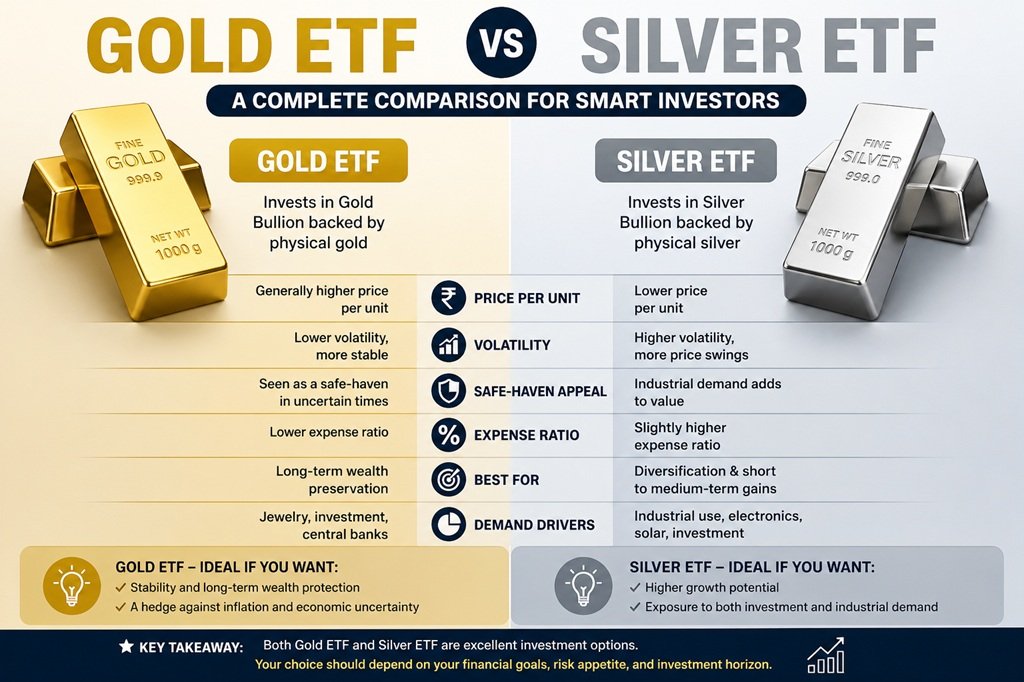
Here’s a simple table to highlight the main differences:
- Asset: Gold ETF → 24K physical gold bullion. Silver ETF → 0.999 pure silver bullion.
- Volatility: Gold → Lower to moderate (more stable). Silver → Higher (can rise or fall faster).
- Main Price Drivers: Gold → Global uncertainty, inflation, central bank buying, currency weakness. Silver → Industrial demand (solar, EVs, electronics) + investment flows.
- Cost/Affordability: Gold → More expensive per unit. Silver → Cheaper, better for smaller investors.
- Liquidity: Gold → Generally higher. Silver → Moderate.
- Historical Role: Gold → Wealth preservation and inflation hedge. Silver → Growth potential with higher risk.
- Best Suited For: Gold → Conservative, long-term investors. Silver → Those comfortable with volatility and seeking higher potential returns.
In recent times (around 2025-2026), silver has shown stronger performance in some periods. For instance, between Akshaya Tritiya 2025 and 2026, silver ETFs delivered returns in the range of 100-115% or even higher in some cases, while gold ETFs gave solid but steadier 50-60% gains. A ₹1 lakh investment in silver could have grown significantly more than in gold during that rally, thanks to industrial demand. However, gold remained more stable.
Over longer periods, gold has often been more consistent, while silver can deliver bigger ups (and downs).
Similarities Between Gold and Silver ETFs
Despite the differences, both have a lot in common:
- Traded on stock exchanges like regular shares.
- Passively managed with low costs.
- No need for physical storage or purity worries.
- Daily NAV (Net Asset Value) based on actual metal prices.
- Help diversify your portfolio away from stocks and fixed deposits.
- Easy to buy through your demat account via any broker app.
Both are great for people who want digital exposure without the traditional headaches.
When Should You Choose Gold ETF?
Go for Gold ETFs if:
- Your goal is long-term wealth preservation and protection against inflation or economic uncertainty.
- You have a lower risk appetite and prefer stability.
- You want a traditional hedge — something that has worked for centuries during crises.
- You’re planning for big life goals like retirement, child’s education, or simply safeguarding savings.
Gold often shines when stock markets are down or when global tensions rise.
When Should You Choose Silver ETF?
Consider Silver ETFs if:
- You’re a beginner or have a limited budget to start with precious metals.
- You’re okay with more ups and downs for the chance of higher returns.
- You believe in the future of green technology, solar energy, and industrial growth.
- You want to add a growth-oriented precious metal to your mix.
Silver can perform well during economic recoveries and tech booms, but be ready for sharper moves.
A Smart Approach: Consider Both?
You don’t always have to choose just one. Many financial experts suggest holding a small portion (say 5-15%) of your portfolio in precious metals. Within that, you could split between gold for stability and silver for growth potential. This balanced approach can reduce overall risk while giving you exposure to different drivers.
For example, if gold acts as your “insurance,” silver can be your “growth kicker” when industries expand.
How Do These ETFs Actually Work?
It’s straightforward:
- You open a demat and trading account.
- Search for the ETF symbol on your broker app (like NSE: GOLD or specific fund names).
- Buy units during market hours.
- The fund holds physical metal in vaults.
- Your returns come from price appreciation minus a small expense ratio.
- Sell whenever you want — the money comes to your account quickly.
Tracking error (how closely the ETF follows the actual metal price) is usually low in good funds. Always check the fund’s size, liquidity, and expense ratio before investing. Bigger, more popular ETFs tend to have tighter tracking and easier buying/selling.
Important Things to Check Before Investing
- Expense Ratio: Lower is better — it directly affects your net returns.
- Liquidity and Tracking Error: Choose ETFs that trade actively and stay close to the metal’s price.
- Fund House Reputation: Go with established names that have strong custody and transparency.
- Your Risk Appetite and Goals: Be honest about how much volatility you can handle.
- Economic Outlook: In high inflation or uncertainty, gold may feel safer. In growth phases, silver might have an edge.
- Diversification: Don’t put all your money here — use it as part of a broader portfolio with equity, debt, etc.
Tax Rules for Gold and Silver ETFs (as of 2026)
Taxation is straightforward but important:
- If you hold for 1 year or less (short-term): Gains are added to your income and taxed at your regular slab rate.
- If you hold for more than 1 year (long-term): Gains are taxed at 12.5% (without indexation benefit). Note that the ₹1.25 lakh exemption available for equity doesn’t apply here.
This is different from physical gold in some older rules, but for ETFs, the 12-month holding period for long-term applies. Always check the latest rules or consult a tax advisor, as they can change. Tax efficiency is one more reason ETFs often beat physical buying.
Final Thoughts
Gold and Silver ETFs have truly changed how ordinary Indians can invest in precious metals. No more worrying about lockers, purity, or high charges. You get clean, digital exposure with good transparency and liquidity.
If stability and wealth protection matter most to you, Gold ETFs are often the safer, more traditional choice. If you have a slightly higher risk appetite and like the idea of industrial growth potential, Silver ETFs can offer exciting opportunities — though with more price swings.
Many people start small with silver because it’s more affordable, then add gold as their portfolio grows. The best strategy? Align your choice with your budget, goals, time horizon, and comfort with ups and downs. And remember, a mix of both can sometimes give you the best of stability and growth.
Before investing, do your own research, check current prices and fund details, and consider speaking with a financial advisor. Precious metals can be a valuable part of your journey, but they work best when used wisely as a diversifier, not as your only investment.
Happy investing — may your portfolio shine, whether in yellow gold or white silver!

