

Imagine spending your entire life mastering a craft — whether it’s shaping clay into beautiful pottery, weaving intricate fabrics, or hammering metal into tools — and still struggling to make ends meet. That’s the reality for millions of traditional artisans and craftspeople across India. They’ve got the skills, the passion, and the heritage, but what they often lack is financial support, modern tools, and a proper platform to grow.
Well, that’s exactly where PM Vishwakarma Yojana steps in, and honestly, it’s about time!
Launched by the Government of India in September 2023, this scheme is specifically designed to uplift the lives of traditional craftsmen and artisans who belong to the Vishwakarma community — a group that’s been the backbone of India’s handmade, handcrafted economy for centuries. From carpenters and blacksmiths to goldsmiths and cobblers, this yojana covers a wide range of skilled workers.
In this article, we’re going to break down everything — the goals, the subsidies, the eligibility criteria, and the complete application process — so that you or someone you know can actually benefit from it. Let’s dive right in!
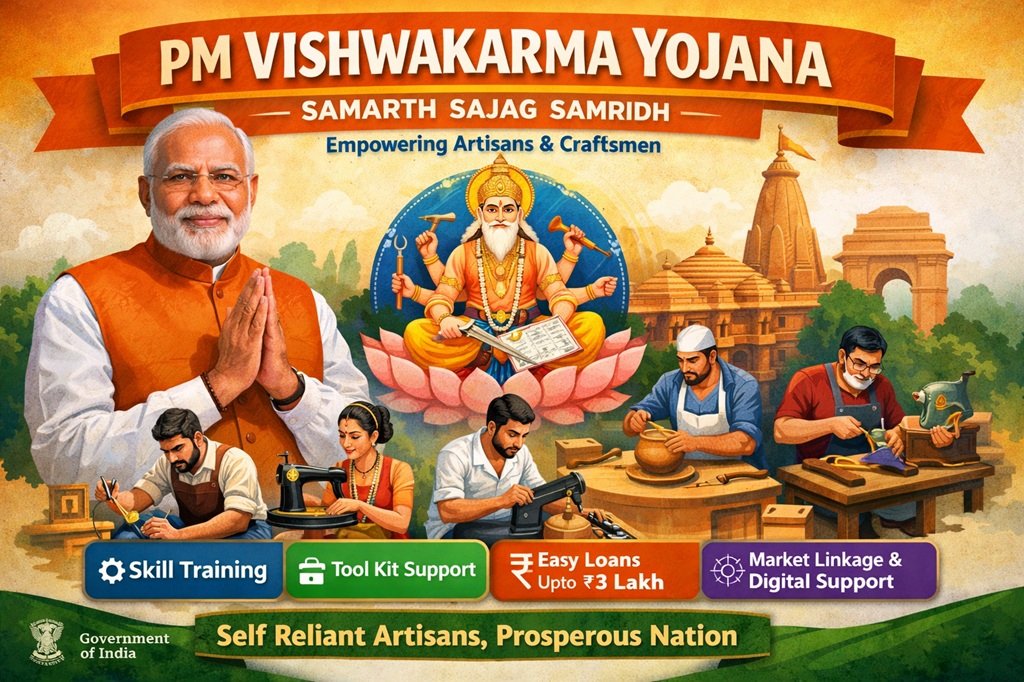
What Is PM Vishwakarma Yojana?
At its core, PM Vishwakarma Yojana is a Central Sector Scheme introduced by Prime Minister Narendra Modi on the occasion of Vishwakarma Jayanti, September 17, 2023. The scheme carries a massive budget of ₹13,000 crore and is set to run until the financial year 2027–28.
The name “Vishwakarma” itself comes from Hindu mythology — Lord Vishwakarma is considered the divine craftsman, the god of architecture and crafts. So, naming this scheme after him isn’t just symbolic; it’s a tribute to the millions of artisans who’ve kept India’s rich craft traditions alive.
Now, what makes this scheme stand out from the dozens of other government programs floating around? It’s the holistic approach. Rather than just handing out money and calling it a day, PM Vishwakarma Yojana offers a complete package — training, certification, financial aid, modern tools, digital integration, and even market support. It’s like giving someone not just a fish, but teaching them how to fish and then helping them sell the fish too!
The Core Goals of PM Vishwakarma Yojana
Understanding what the scheme is trying to achieve helps you appreciate why it matters so much. Here’s what the government is aiming for:
Recognizing and Validating Traditional Skills
For decades, traditional craftsmen have worked without any formal recognition. They don’t have certificates, degrees, or diplomas — just years of hands-on experience passed down through generations. PM Vishwakarma Yojana aims to change that by providing artisans with a formal PM Vishwakarma Certificate and ID Card, which validates their skills and identity as certified craftsmen.
This recognition isn’t just emotional — it opens doors to bank loans, government tenders, and marketplace access that were previously out of reach.
Upgrading Skills Through Quality Training
Here’s the thing: even the most talented craftsman can benefit from new techniques, better tools, and updated methods. The scheme provides both basic and advanced training programs to help artisans sharpen their skills while also introducing them to modern practices.
Basic training lasts five days, and during this time, participants also receive a daily stipend of ₹500. Advanced training can last up to 15 days with the same daily benefit. It’s not just about learning — it’s about being compensated for your time while you learn, which makes the program genuinely accessible to people who can’t afford to take time off work.
Providing Financial Assistance Through Collateral-Free Loans
Let’s be real — getting a loan from a bank without collateral is nearly impossible for most small-scale artisans. PM Vishwakarma Yojana tackles this head-on by offering collateral-free enterprise development loans in two tranches:
- First tranche: Up to ₹1 lakh
- Second tranche: Up to ₹2 lakh
And here’s the kicker — the interest rate on these loans is heavily subsidized at just 5% per annum, even though the actual rate is much higher. The government bears the difference, so beneficiaries don’t feel the pinch.
Providing Modern Tool Support
Many artisans are still using the same outdated tools their grandparents used. While there’s beauty in tradition, outdated tools can slow down production and affect quality. Under this scheme, artisans receive a toolkit incentive of ₹15,000, which they can use to purchase modern, updated tools relevant to their trade. This small but significant support can dramatically improve productivity and product quality.
Integrating Artisans Into the Digital Economy
We’re living in a digital world, aren’t we? But many traditional craftsmen have been left completely out of it. PM Vishwakarma Yojana includes digital training components that help artisans learn about digital payments, online marketing, and e-commerce. The goal is to help them sell their products beyond their local village or town — to customers across India and even globally.
Connecting Artisans to Broader Markets
It’s not enough to make a beautiful product if nobody knows it exists. The scheme also focuses on market linkages by connecting artisans to national and international markets, government e-marketplace platforms, and trade fairs.
Who Is Eligible for PM Vishwakarma Yojana?
This is one of the most common questions people ask, and rightfully so. Not everyone qualifies, so let’s clear this up.
Eligible Trades
The scheme currently covers 18 traditional trade categories, including:
- Carpenter (Suthar/Badhai)
- Boat Maker
- Armourer
- Blacksmith (Lohar)
- Hammer and Tool Kit Maker
- Locksmith
- Goldsmith (Sonar)
- Potter (Kumhar)
- Sculptor / Stone Carver
- Cobbler (Mochi/Chamarwa)
- Mason (Rajmistri)
- Basket/Mat/Broom Maker
- Doll and Toy Maker
- Barber (Naai)
- Garland Maker (Malakaar)
- Washerman (Dhobi)
- Tailor (Darzi)
- Fishing Net Maker
Basic Eligibility Criteria
To qualify for PM Vishwakarma Yojana, an applicant must:
- Be engaged in one of the 18 listed trades on a self-employment or unorganized sector basis
- Be at least 18 years of age at the time of registration
- Not be enrolled in any similar central or state government scheme such as PM MUDRA Yojana or PM SVANidhi in the last 5 years (for the loan component)
- Only one member per family can register
- Government employees and their immediate family members are not eligible
It’s worth noting that the scheme is open to artisans across all states and union territories, so geography isn’t a barrier here.
The Subsidy Structure
Let’s talk money — because that’s what most people really want to know about when they hear “government scheme.” Here’s a clean summary of the financial and non-financial benefits under PM Vishwakarma Yojana:
Training Stipend
- ₹500 per day during basic training (5 days)
- ₹500 per day during advanced training (up to 15 days)
Toolkit Incentive
- A one-time grant of ₹15,000 to purchase modern tools — this is not a loan; it’s a direct benefit!
Collateral-Free Credit Support
- 1st loan: ₹1 lakh at a concessional 5% interest rate
- 2nd loan: ₹2 lakh at 5% interest (available after satisfactory repayment of the first loan)
Digital Transaction Incentive
- ₹1 per digital transaction, up to 100 transactions per month, for artisans who adopt digital payment methods
Marketing Support
- Assistance with branding, packaging, and access to national and international trade fair participation
- Onboarding support on government e-marketplace (GeM) portal
Altogether, the total benefit per artisan can easily cross ₹3 lakh or more when you factor in training stipends, toolkits, loans, and transaction incentives. That’s not a small deal for someone who’s been scraping by with limited resources.
Step-by-Step Application Process for PM Vishwakarma Yojana
Alright, so you’re convinced this scheme is worth exploring. But how do you actually apply? Don’t worry — it’s simpler than you might think, though it does require a few documents and steps.
Step 1: Visit the Official Portal
Head over to the official website at pmvishwakarma.gov.in. This is the only official platform for registration, so steer clear of any third-party websites claiming to help with the process — many of them are scams!
Step 2: Register Through a Common Service Centre (CSC)
Here’s something important: individual artisans cannot register directly on the portal themselves. Registration must be done through a CSC (Common Service Centre) or Gram Panchayat, where a trained operator will assist you with the process.
You’ll need to carry the following documents:
- Aadhaar card
- Mobile number linked with Aadhaar
- Bank account details (preferably Jan Dhan or regular savings account)
- Ration card (if available)
- Caste certificate (if applicable)
The CSC operator will verify your details using biometric authentication linked to your Aadhaar.
Step 3: Get Your PM Vishwakarma Certificate and ID
Once your registration is approved, you’ll receive a PM Vishwakarma Certificate and a unique ID card. Congratulations — you’re now officially recognized as a Vishwakarma artisan!
Step 4: Enroll for Basic Training
After registration, you’ll be directed to enroll in a basic skill training program at a designated training center near you. This is mandatory before you can access most of the financial benefits.
Remember, you’ll receive ₹500 per day during this training period — so it’s definitely worth showing up!
Step 5: Apply for the Toolkit Incentive
After completing training, you can apply for the ₹15,000 toolkit grant. The amount is credited directly to your bank account through DBT (Direct Benefit Transfer), and you can then use it to purchase tools of your choice from designated vendors or the open market.
Step 6: Apply for the Credit/Loan Component
Once you’ve got your certificate and completed your training, you become eligible to apply for the collateral-free loan. The loan is processed through partner banks and financial institutions. You’ll need to submit your PM Vishwakarma ID and basic KYC details.
The repayment tenure for the first loan is 18 months, and the second loan can be repaid over 30 months.
Step 7: Digital and Market Integration
As a final step, you’ll be supported in setting up digital payment capabilities and may be onboarded to GeM or other e-commerce platforms. This helps you reach a bigger customer base and grow your business sustainably.
Challenges and Limitations
No scheme is perfect, and PM Vishwakarma Yojana has its share of challenges too. It’s important to talk about them so that potential beneficiaries go in with realistic expectations.
Firstly, awareness is a major issue. Many eligible artisans in rural areas simply don’t know this scheme exists. The dependence on CSC centers for registration can also be a bottleneck in areas where these centers are far away or understaffed.
Secondly, digital literacy remains a challenge. The scheme encourages digital payments and e-commerce, but many artisans aren’t comfortable with smartphones or the internet yet. More handholding is needed here.
Thirdly, there are concerns about loan repayment pressure. Even at 5% interest, if an artisan doesn’t see a significant improvement in income quickly enough, repaying ₹1 lakh in 18 months can feel daunting.
That said, the government has been steadily improving implementation with feedback from the ground level, and the scheme is evolving. Critics might point out these gaps, but the foundational intent and structure of PM Vishwakarma Yojana is genuinely well-designed for its target audience.
Real Impact
Since its launch, PM Vishwakarma Yojana has registered millions of artisans across India. States like Uttar Pradesh, Rajasthan, Gujarat, and Tamil Nadu have seen particularly strong uptake, given their rich tradition of handicrafts and artisanal work.
Artisans who’ve gone through the program have reported not just financial relief, but a sense of dignity and recognition that was previously missing. A carpenter in a small village who receives an official government certificate validating his craft feels seen — and that emotional boost can be just as powerful as the financial support.
Women artisans, in particular, have benefited significantly. Many women in rural India are skilled in weaving, pottery, and tailoring but never had access to formal financial services. This scheme has opened those doors in a meaningful way.
Frequently Asked Questions (FAQs)
Q1. Is PM Vishwakarma Yojana only for people from the Vishwakarma caste?
No, it’s not strictly caste-based. The scheme is open to traditional artisans and craftspeople working in the 18 listed trades, regardless of caste or religion, as long as they meet the eligibility criteria.
Q2. Can a woman artisan apply for PM Vishwakarma Yojana?
Absolutely! Women artisans are equally eligible and are, in fact, encouraged to apply. The scheme actively supports female beneficiaries.
Q3. What if I don’t have a smartphone or internet access?
That’s okay! You can visit your nearest CSC center or Gram Panchayat to complete the registration process with assistance. You don’t need to have internet access at home.
Q4. Can I apply for both the toolkit grant and the loan? Yes, both benefits are available to eligible artisans. However, the loan is processed separately and requires you to have completed your training and received your certificate first.
Q5. How long does it take to get the loan approved?
Processing times vary depending on the bank, but generally, once your application is complete and verified, it can take anywhere from a few days to a few weeks.
Q6. Is there an age limit for applying?
Yes, you must be at least 18 years old. There is no upper age limit mentioned in the official guidelines, so even senior artisans can apply.
Q7. What happens if I default on the loan repayment?
Like any bank loan, defaulting can affect your credit score and may disqualify you from future benefits. It’s important to plan your finances carefully before taking the loan.
Conclusion
There’s no denying it — PM Vishwakarma Yojana is one of the most thoughtfully designed government schemes for India’s vast community of traditional artisans. It doesn’t just throw money at the problem; it addresses the root causes — lack of recognition, outdated tools, no access to credit, and limited market reach — with a structured, multi-pronged solution.
Sure, there are implementation challenges to iron out, and not every artisan may have immediate access to the scheme. But the intent is clear and the impact, so far, has been genuinely positive. Millions of craftsmen and craftswomen are finally getting the kind of support they’ve deserved for generations.
If you or someone you know falls into one of the 18 eligible trade categories, don’t wait around — head to your nearest CSC center and start the registration process. The benefits are real, the process is accessible, and the support is there for the taking.
India’s artisans have kept centuries of tradition alive with their bare hands. It’s only fair that PM Vishwakarma Yojana now lends those hands a helping one.

