

Multi Cap Mutual Funds are diversified equity mutual fund schemes that invest across large-cap, mid-cap, and small-cap stocks with a mandated allocation structure. These funds are designed to provide balanced exposure to companies of all market capitalizations, helping investors participate in both stability and high-growth opportunities.
If you’re eyeing ways to grow your money in India’s buzzing economy, you’ve probably heard the buzz about multi cap funds. These aren’t just any investment vehicles; they’re like the Swiss Army knives of mutual funds, dipping into companies of all sizes—big, medium, and small—to spread out the risks and snag opportunities wherever they pop up. As we roll into 2026, with the stock market swinging like a pendulum amid global uncertainties and local reforms, picking the right top multi cap funds to invest in India 2026 could be your ticket to solid returns. But hold on, it’s not about jumping in blindly; it’s about understanding what makes these funds tick and why they’re gaining traction now more than ever.
Picture this: India’s GDP is chugging along at a healthy clip, tech startups are exploding, and traditional sectors like manufacturing are getting a makeover thanks to government pushes. In this mix, multi cap funds shine because they aren’t boxed into one category. They can pivot quickly, grabbing shares from giants like Reliance or HDFC Bank when stability’s key, or betting on mid-sized gems in renewable energy that might skyrocket. And get this—according to recent data, these funds have been outperforming many single-cap options over the past few years, especially in volatile times. So, if you’re wondering where to park your hard-earned cash, stick around as we dive into the top multi cap funds to invest in India 2026, breaking it down simply without all the jargon that makes your head spin.
What Exactly Are Multi Cap Funds?
Alright, let’s break it down nice and easy. Multi cap funds, sometimes called multicap funds, are mutual funds that invest across the board—in large-cap, mid-cap, and small-cap stocks. No strict rules here; fund managers have the freedom to allocate as they see fit, usually aiming for at least 25% in each category to keep things balanced. It’s like having a diversified basket of eggs, so if one cracks, the others hold up.
Why the hype in 2026? Well, with India’s market maturing, these funds let you ride the wave of growth in various sectors without putting all your bets on one horse. For instance, while large caps offer stability like a rock-solid foundation, mid and small caps bring the excitement of potential high flyers. And here’s a fun fact: SEBI, India’s market watchdog, tweaked the rules a few years back to ensure these funds truly spread out, making them even more appealing for folks looking for that sweet spot between risk and reward.
Transitional phrases aside, jumping into multi cap funds means you’re not missing out on the next big thing, whether it’s a tech disruptor or a steady consumer goods player. But remember, they’re equity-focused, so they’re best for those with a horizon of at least five years—patience pays off, right?
Why Invest in Top Multi Cap Funds in India 2026?
Oh boy, where do I start? Investing in top multi cap funds to invest in India 2026 is like gearing up for a marathon in a year that’s shaping up to be full of surprises. First off, diversification is the name of the game. In a world where economic shifts happen faster than you can say “bull market,” these funds shield you from nasty surprises by spreading investments wide.
Take the benefits one by one:
- Flexibility Galore: Fund managers can shuffle allocations based on market vibes. If small caps are booming, they amp up there; if large caps are the safe bet during downturns, that’s where the money flows. No rigid caps holding them back!
- Potential for Higher Returns: Historically, multi cap funds have delivered juicy returns. For example, over the last five years, many have clocked in at 15-20% annualized, outpacing fixed deposits by a mile. And in 2026, with India’s push towards digital economy and infrastructure, expect even more upside.
- Risk Management Built-In: Sure, stocks can be bumpy, but by mixing sizes, these funds smooth out the ride. It’s not as wild as pure small-cap funds, yet punchier than large-cap snoozers.
- Tax Perks: Long-term gains over a year get taxed at just 12.5% beyond ₹1.25 lakh, making them tax-efficient for patient investors. Plus, SIPs (Systematic Investment Plans) let you average out costs over time.
But hey, don’t just take my word for it—experts are raving about how multi cap funds are ideal for India’s growth story, especially with reforms like PLI schemes boosting manufacturing. If you’re in your 30s or 40s, building wealth? These could be your go-to. Exclamation point: What a smart move in uncertain times!
Key Factors to Consider Before Picking Top Multi Cap Funds
Alright, before you dive headfirst into the top multi cap funds to invest in India 2026, let’s chat about what to watch for. Not all funds are created equal, and picking the wrong one could leave you scratching your head.
First, look at past performance—but don’t obsess over it. A fund that’s shone for 3-5 years, like those with consistent 18-22% returns, shows resilience. Check the expense ratio too; lower is better, ideally under 1%, so more of your money works for you.
Then there’s the fund manager’s track record. Have they navigated crashes like 2020’s pandemic dip? Experience counts big time.
Asset Under Management (AUM) matters—bigger funds like those over ₹10,000 crore offer liquidity, but smaller ones might be nimbler.
Risk metrics: Sharpe ratio for risk-adjusted returns, beta for volatility. Aim for a Sharpe over 1.
And don’t forget your own goals. Aggressive? Go for funds heavy on mid/small caps. Conservative? Lean towards large-cap tilted ones.
Finally, read the scheme info document. Boring? Yeah, but it spells out the strategy, avoiding nasty surprises down the road.
Top Multi Cap Funds to Invest in India 2026
Now, the meaty part! Based on recent performance, AUM, and expert picks, here are some standout top multi cap funds to invest in India 2026. I’ve focused on direct growth plans for better returns, minus the distributor cut. These aren’t recommendations—do your homework or chat with an advisor—but they’re worth a look.
Nippon India Multi Cap Fund Direct Growth
The Nippon India Multi Cap Fund Direct Growth is a popular multi-cap equity scheme from Nippon India Mutual Fund, launched on January 1, 2013, giving it over 13 years of track record in navigating India’s diverse market landscape.
This fund follows a multi-cap mandate, allocating across large-, mid-, and small-cap stocks with a required minimum of 25% in each category, offering balanced exposure without the full flexibility of pure flexi-caps.
As of mid-February 2026 (around February 17-18), the latest NAV stands at approximately ₹330.85, showing steady appreciation from its earlier levels amid recent market fluctuations.
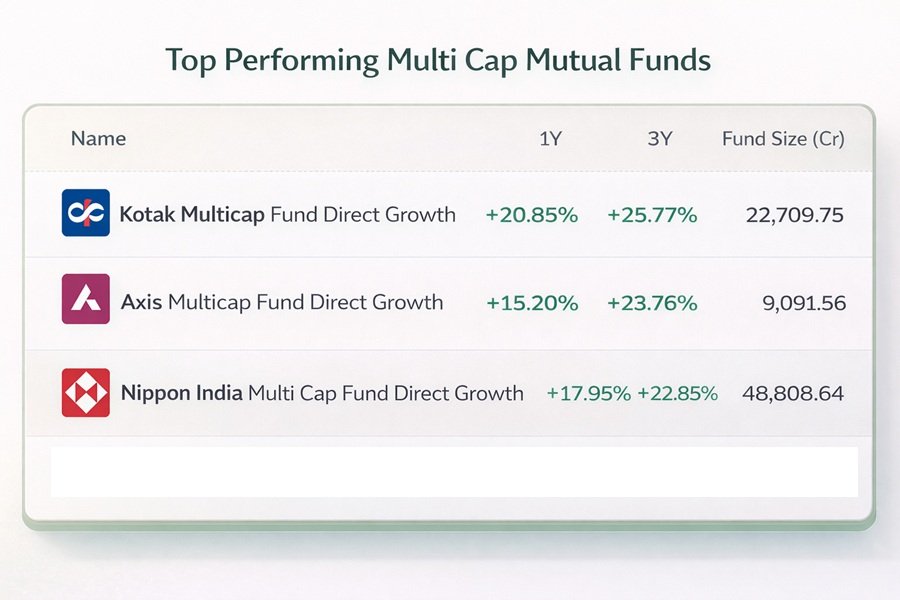
Performance has been standout: over the past five years, it has delivered strong annualized returns of around 22.50% to 22.69%, often topping or ranking high in the multi-cap category.
In the last three years, trailing annualized returns hover at about 22.53% to 22.56%, reflecting robust compounding through volatile phases and beating category averages.
For the trailing one year, returns come in around 17.44% to 17.95%, a solid showing despite some broader market corrections in recent months.
The fund’s AUM has ballooned to roughly ₹48,809 crore (as of early 2026 data), making it one of the largest in its space with excellent liquidity for investors.
With a low expense ratio of about 0.70% to 0.72% for the direct plan, it keeps costs efficient, letting more returns flow to unitholders over the long haul.
Kotak Multicap Fund Direct Growth
The Kotak Multicap Fund Direct Growth is a robust multi-cap equity scheme from Kotak Mahindra Mutual Fund, launched on September 29, 2021, giving it roughly 4.5 years of operating history in India’s evolving markets.
This fund sticks to a classic multi-cap mandate, investing at least 25% each in large-, mid-, and small-cap stocks, providing balanced diversification across market caps without the full roaming freedom of flexi-caps.
As of mid-February 2026 (around February 17), the latest NAV stands at approximately ₹21.28, up from its launch levels and showing resilience amid recent market ups and downs.
Performance shines brightly: over the past three years, it has delivered impressive annualized returns of around 25.80%, often ranking at the top or near the top in the multi-cap category.
In the last one year, trailing returns hover around 20.85%, a strong showing that beats the category average and holds up well despite some broader corrections.
Since inception, the fund has posted solid annualized returns of about 18.78% to 18.8%, reflecting consistent compounding for long-term holders.
The fund’s AUM has swelled to roughly ₹22,710 crore (as of early 2026 figures), making it one of the larger players in its space with good liquidity.
With a super-low expense ratio of just 0.45% for the direct plan, it keeps costs minimal, so more gains stay with investors over time—always a winner!
Axis Multicap Fund Direct Growth
The Axis Multicap Fund Direct Growth is a solid multi-cap equity offering from Axis Mutual Fund, launched on December 17, 2021, providing it with about 4+ years of market experience in India’s multi-cap space.
This fund adheres to the classic multi-cap mandate, allocating at least 25% each to large-, mid-, and small-cap stocks, delivering balanced exposure across market segments.
As of mid-February 2026 (around February 17), the latest NAV stands at approximately ₹18.95, reflecting gradual appreciation from its launch base amid ongoing market dynamics.
Performance has been impressive on the longer horizon: over the past three years, it has delivered strong annualized returns of around 23.37%, often ranking high in the multi-cap category and outperforming averages.
In the trailing one year, returns come in at about 14.42% to 15.20%, a decent hold-up given recent corrections and competitive with or slightly above category peers.
Since inception, the fund has posted consistent annualized returns of roughly 16.49% to 16.59%, beating its benchmark (Nifty 500 Multicap 50:25:25 TRI) which sits lower at around 16.04% in comparable periods.
The fund’s AUM has grown healthily to approximately ₹9,092 crore (as of early February 2026 data), showing strong investor inflows and solid liquidity.
With a low expense ratio of about 0.71% to 0.72% for the direct plan, it remains cost-efficient, helping maximize long-term compounding for investors.
How to Start Investing in Multi Cap Funds
Getting started? Piece of cake! First, open a demat account or use apps like Groww, ET Money, or Zerodha. Choose direct plans to skip commissions.
Opt for SIPs—invest fixed amounts monthly, say ₹500, to average costs. Lumpsum if you’ve got a windfall.
Track via apps, rebalance yearly. And tax? Equity rules apply.
In 2026, with digital ease, it’s simpler than ever. Just don’t invest what you can’t afford to lose—common sense, folks!
Risks to Keep in Mind with Multi Cap Funds
No sugarcoating: Multi cap funds aren’t risk-free. Market volatility can hit hard, especially small caps. Economic slowdowns? Returns dip.
Interest rate hikes could pressure growth stocks. Fund manager changes might shake things up.
Diversify your portfolio—don’t go all-in on one fund. And remember, past performance isn’t a guarantee; 2026 could bring surprises like geopolitical tensions.
But with risks come rewards—calculated bets pay off!
FAQs
What are the minimum investments for these funds?
Most start at ₹100 for SIPs, ₹5,000 for lumpsum. Easy entry!
Are multi cap funds better than flexi cap?
Similar, but multi cap mandates diversification across caps, while flexi cap has more freedom. Depends on your style.
How do taxes work?
Short-term (under a year): 20%. Long-term: 12.5% over ₹1.25 lakh gains.
Can NRIs invest?
Yep, but with some paperwork.
What’s the ideal holding period?
5-7 years for best results—compounding magic!
How to choose between active and passive multi cap funds?
Active for manager expertise; passive for low costs tracking indices.
Are these suitable for retirees?
Maybe a small portion; they’re equity-heavy, so volatile.
What if markets crash in 2026?
Stay put—long-term, they recover. Panic selling hurts!
Conclusion
Wrapping it up, diving into top multi cap funds to invest in India 2026 could be a game-changer for your finances. With their blend of flexibility, diversification, and growth potential, they’re tailor-made for India’s evolving landscape—from tech booms to infra leaps. We’ve covered the basics, spotlighted stars like Nippon India and Kotak, and flagged the risks, all in simple terms.
Remember, investing’s a marathon, not a sprint. Start small, stay consistent, and keep an eye on trends. If you’re ready to build wealth without the headaches of stock picking, multi cap funds might just be your ally. Here’s to smarter investing in 2026—may your returns be as exciting as the journey!

