

If you are a government employee, work in a public sector job, or belong to certain approved professions, you might have heard about Postal Life Insurance, or PLI as most people call it. It is one of the oldest and most trusted life insurance options in India. Many families rely on it for financial security because it offers solid protection at very reasonable costs. In this detailed guide, we will walk through what PLI is, its long history, the different plans available, who can join, how it works, its benefits, and practical steps to get started or manage a policy. We will use easy language and add plenty of real-life examples so you can understand it clearly.
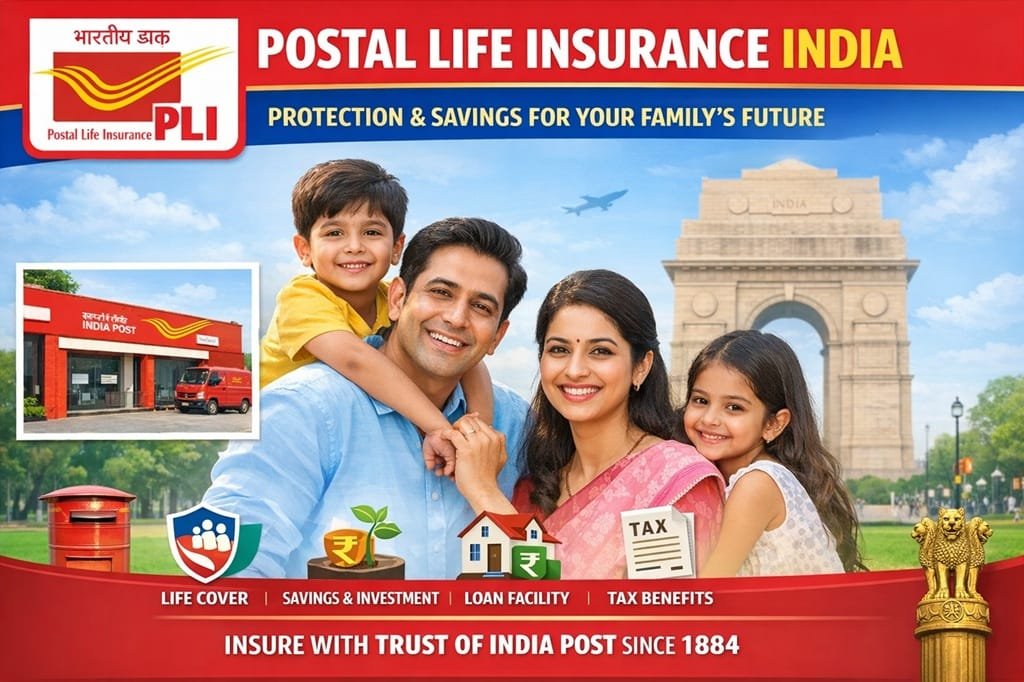
What Exactly Is Postal Life Insurance?
Postal Life Insurance is a life insurance scheme run by the Department of Posts, which is part of the Government of India. It combines two important things: life cover that protects your family if something happens to you, and a savings component that grows over time with bonuses. When you buy a PLI policy, you pay regular premiums. If you pass away during the policy term, your family (the nominee) receives the sum assured plus any bonuses that have built up. If you survive until the end of the term (maturity), you or your family get the sum assured along with bonuses.
Unlike many private insurance plans that can feel complicated or expensive, PLI stands out because of its low premiums and strong government backing. It feels safe and straightforward for people who want peace of mind without high costs. The scheme started small but has grown hugely over the years, serving millions of policyholders across the country.
The Rich History of Postal Life Insurance
Postal Life Insurance has a fascinating story that goes back more than 140 years. It began on February 1, 1884, mainly to help postal employees and their families. At that time, the Director General of Post Offices, Mr. F.R. Hogg, suggested the idea as a welfare measure. The British government approved it, and it started as a simple insurance plan for post office workers.
In 1888, it expanded to include employees of the Telegraph Department. By 1894, it became one of the first insurers in India to cover female employees—a big step forward when many private companies did not offer policies to women. The initial maximum coverage was just ₹4,000, which seems tiny today. Now, the limit has risen significantly to up to ₹50 lakh for most plans, making it much more useful for modern needs.
Over the decades, PLI opened its doors wider. Today, it serves not just postal staff but also central and state government employees, defense personnel, paramilitary forces, public sector undertakings (PSUs), nationalized banks, universities, government-aided schools and colleges, local bodies, autonomous organizations, and even professionals like doctors, engineers, chartered accountants, lawyers, MBAs, and employees of companies listed on the NSE or BSE. This growth shows how the government has tried to make reliable insurance available to a large section of working people who value stability and affordability.
Main Features That Make PLI Special
People choose PLI for several practical reasons. Here are the key features explained simply:
- Low Premiums with High Returns: PLI premiums are often lower than similar plans from private companies. At the same time, it declares attractive bonus rates every year. These bonuses add to your policy value and can make the final payout quite rewarding.
- Government Security: Because it is backed by the Government of India, policyholders feel confident that their money is safe. There is almost no risk of the insurer failing to pay claims.
- Loan Facility: After a few years (usually 3 or 4, depending on the plan), you can take a loan against your policy. This helps in emergencies like medical needs, children’s education, or home repairs without breaking the policy.
- Nomination and Easy Changes: You can name one or more family members as nominees. You can also change the nomination anytime if your family situation changes.
- Policy Transfer and Portability: If you move to another city or state within India, you can easily transfer your policy to the nearest post office. This makes it convenient for people who relocate often.
- Duplicate Policy Document: If your policy bond gets lost, damaged, or stolen, the post office can issue a duplicate after proper verification.
- Conversion Options: Some plans allow you to convert from one type to another within certain time limits, giving flexibility as your needs change.
- Online and Digital Services: You can register on the India Post customer portal, pay premiums online, check policy status, and do many transactions through the app or website. This has made managing PLI much easier in today’s digital world.
- Flexible Premium Payment: Pay monthly, quarterly, half-yearly, or yearly. You can use cash, cheque, online banking, cards, or even set up automatic debit.
These features together make PLI feel like a reliable friend for long-term financial planning rather than just another insurance product.
The Different Types of PLI Plans Explained in Detail
PLI offers six main plans. Each one suits different life stages and goals. Let’s look at them one by one with clear explanations, eligibility, and examples.
- Whole Life Assurance (Suraksha Scheme) This plan provides coverage for your entire life, up to age 80 or beyond in some cases. The sum assured plus bonuses is paid either when you turn 80 (or the chosen cessation age) or to your nominee if you pass away earlier. It is ideal for people who want lifelong protection and a good payout for their family.
- Entry age: 19 to 55 years
- Sum assured: Minimum ₹20,000, maximum ₹50 lakh
- Loan available after 4 years
- Surrender possible after 3 years
- Bonus eligibility after 5 years
- You can convert it to an Endowment plan up to age 59 in many cases
Example: A 30-year-old person buys a ₹5 lakh policy. Premiums are quite low. Over many years, bonuses accumulate, and the family gets a substantial amount if needed. Many parents choose this to leave a legacy for their children.
- Endowment Assurance (Santosh Scheme) This is a popular savings-cum-insurance plan. You choose a maturity age (like 35, 40, 45, 50, 55, 58, or 60). At maturity, you get the sum assured plus bonuses. If you die before that, your family receives the full amount with bonuses.
- Entry age: 19 to 55 years
- Sum assured: ₹20,000 to ₹50 lakh
- Loan after 3 years
- Surrender after 3 years
- Bonuses start after 5 years
This plan works well for goals like children’s marriage or retirement. Suppose a 35-year-old takes a 20-year policy for ₹10 lakh. At the end of 20 years (age 55), they receive the original amount plus all the bonuses declared over the years. It feels like forced savings that also protects the family.
- Anticipated Endowment Assurance (Sumangal Scheme) – The Money-Back Plan This is like a money-back policy. You get part of the sum assured at regular intervals while you are alive, and the remaining plus bonuses at the end. Even if you die, the full sum assured plus bonuses goes to the nominee without deducting the survival benefits already paid.
- Policy term: 15 or 20 years
- Entry age: 19-45 years (for 15-year term) or 19-40 years (for 20-year term)
- Survival benefits: For 15-year policy – 20% at the end of 6, 9, and 12 years; 40% plus bonus at maturity. Similar structure for 20-year term.
This plan is great for people who need periodic cash flows, such as for education fees or other planned expenses. It provides liquidity without fully ending the policy.
- Convertible Whole Life Assurance (Suvidha Scheme) This starts as a whole life plan but gives you the option to convert it into an endowment plan after 5 years but before the end of 6 years. It offers flexibility if your financial situation or goals change.
- Entry age: 19 to 55 years (some sources mention up to 50)
- Other features similar to whole life, with conversion benefit
Many young professionals start with this because it gives them time to decide on a fixed maturity date later.
- Joint Life Assurance (Yugal Suraksha Scheme) This covers both husband and wife under one policy. A single premium covers the combined sum assured. On the death of one spouse, the surviving spouse gets the benefits, and the policy can continue.
- Age of spouses: 21 to 45 years
- Sum assured: ₹20,000 to ₹50 lakh
- Term: 5 to 20 years
- Loan and surrender after 3 years
It is a thoughtful choice for married couples who want to protect each other with one simple policy.
- Children Policy (Bal Jeevan Bima) This secures your child’s future. The parent is the policyholder, and up to two children can be covered. If the parent dies, future premiums are waived, and the child still gets the full maturity benefit.
- Child’s age: 5 to 20 years
- Parent’s maximum age: 45 years
- Maximum sum assured: ₹3 lakh or the parent’s own sum assured, whichever is lower
- No loan or surrender option in most cases
- No medical exam needed if the child is healthy
Parents love this plan because it ensures the child’s education or marriage goals are protected even in difficult times.
Who Can Buy PLI? Eligibility Made Simple
Eligibility is straightforward but specific. You need to be an employee of one of these:
- Central or State Government departments
- Defense services and paramilitary forces
- Public Sector Undertakings (PSUs)
- Nationalized banks and financial institutions
- Government-aided educational institutions, universities, and autonomous bodies
- Local bodies and municipalities
- Professionals such as doctors, engineers, chartered accountants, lawyers, journalists, MBAs
- Employees of companies listed on NSE or BSE
- Department of Posts staff
- Certain contract employees whose contracts can be extended
Spouses and children may also get coverage under certain plans. The idea is to serve people in stable jobs who value government-backed security. If you are not sure whether your organization qualifies, simply visit your nearest post office or check the official India Post website—they are very helpful.
How Bonuses Work in PLI
One of the biggest attractions of PLI is the bonus. Every year, the government declares a simple reversionary bonus based on the performance of the Post Office Life Insurance Fund. These bonuses are added to your policy and paid out at maturity or death.
Current bonus rates (as declared for recent years like 2025-26 and 2026-27) are approximately:
- Whole Life Assurance (Suraksha): ₹76 per ₹1,000 sum assured per year
- Endowment Assurance (Santosh, Joint Life, Children): ₹52 per ₹1,000 per year
- Anticipated Endowment (Sumangal): ₹48 per ₹1,000 per year
- Convertible plans follow whole life rates until converted
There is also a terminal bonus for longer-term policies (20 years or more) in some cases, which can add extra value. Over 20-30 years, these bonuses can significantly increase your final payout. Many policyholders are pleasantly surprised when they see the maturity amount because the bonuses keep compounding the value in a steady way.
Important Benefits and Tax Advantages
PLI offers several practical benefits:
- Affordable Protection and Savings: Lower premiums mean more people can afford decent coverage.
- High Claim Settlement: Being government-run, claims are processed smoothly and reliably.
- Loan Against Policy: Easy access to funds when needed.
- Portability: Move anywhere in India without losing your policy.
- Tax Benefits: Premiums paid qualify for deduction under Section 80C of the Income Tax Act (up to the overall limit). Maturity proceeds are usually tax-free under Section 10(10D) if the policy meets basic conditions (premium not more than 10% of sum assured in most cases). This makes the effective returns even better.
Compared to bank fixed deposits, PLI often gives better long-term value because of bonuses and tax benefits, though FDs offer more liquidity. Compared to many private life insurance plans, PLI usually has lower costs and competitive or better bonuses for eligible people.
How to Buy a PLI Policy – Step by Step
Buying a policy is simple:
- Check Eligibility: Confirm you or your organization qualifies.
- Decide the Plan and Amount: Think about your goals, age, income, and family needs.
- Fill the Proposal Form: Download from the India Post website or get it at any post office. Fill it carefully in capital letters and attach documents like ID proof, address proof, age proof, and employment certificate.
- Submit and Pay First Premium: You can submit at a post office or, in some cases, start online.
- Medical Examination (if needed): For higher sums, a simple medical check may be required.
- Policy Issuance: Once approved, you receive the policy bond.
You can also explore online purchase options through the PLI portal for convenience.
Managing Your Policy: Payments, Login, and Services
Online Portal and App: Register on the India Post customer portal (pli.indiapost.gov.in). Generate your Customer ID using your policy number, date of birth, and sum assured. Pay premiums easily, track status, request services, and more.
Payment Methods:
- India Post Payments Bank (IPPB) app – very convenient with standing instructions
- Internet banking through DoP
- Credit/debit card or net banking on the portal
- Common Service Centres (CSC)
- Cash or cheque at any post office
Checking Policy Status: Log in to the portal or call the toll-free number 1800-180-5230 / 155232.
Loans, Surrender, Revival, and Claims:
- For loans: Submit a request after the waiting period with the policy bond.
- Surrender: Possible after 3 years, but you may lose some bonuses.
- Revival: Pay overdue premiums with interest to bring a lapsed policy back.
- Maturity Claim: Submit the bond, ID proof, and claim form at the post office.
- Death Claim: Nominee submits required documents; process is usually quick.
Keep your policy document safe, inform your family about it, and update your contact details regularly.
Premium Examples and Calculations
Premiums depend on your age, sum assured, plan, and term. They are generally very affordable. For instance, a young person in their 20s or 30s might pay only a few hundred rupees per month for a few lakhs of coverage. Official premium tables are available on the India Post website or at post offices. Many people use these tables or consult postal agents to calculate exact amounts.
PLI vs Other Options – A Quick Comparison
Many wonder how PLI compares with LIC or private insurers. PLI often wins on cost and bonuses for eligible customers, though LIC and private companies offer more plan variety and digital features for everyone. PLI is not available to the general public like private plans, but for those who qualify, it frequently provides better value in the long run.
A Note on Rural Postal Life Insurance (RPLI)
For people living in rural areas, there is a similar scheme called Rural Postal Life Insurance (RPLI) with plans like Gram Suraksha, Gram Santosh, etc. It follows similar principles but has slightly different limits and is open to a broader rural population.
Frequently Asked Questions
Is PLI better than LIC?
For eligible people, PLI often has lower premiums and competitive bonuses. LIC has more branches and plans for everyone.
Which plan is best?
It depends on your age and goals. Young people may like Endowment or Convertible plans. Parents often choose Children Policy or Whole Life.
Is the maturity amount taxable?
Usually no, if conditions are met.
Can I pay premiums late?
Yes, but revive the policy soon to avoid losing benefits.
How safe is PLI?
Extremely safe as it is government-backed.
Final Tips Before You Decide
Take time to understand your family’s needs. Speak to a postal insurance agent or visit a post office—they are knowledgeable and patient. Compare a few plans on paper. Start early because younger age means lower premiums and more time for bonuses to grow. Regularly review your policy as life changes.
Postal Life Insurance has helped generations of Indian families feel secure. Its simple approach, low costs, and reliable payouts make it a timeless choice for many. If you qualify, it is worth exploring seriously. For the latest details, always check the official India Post PLI portal or your local post office, as rules and rates can be updated from time to time.
By choosing PLI, you are not just buying insurance—you are investing in your family’s future with one of India’s most trusted institutions. Feel free to reach out to India Post for personalized guidance. Your financial peace of mind is worth it.

 covering policy types, benefits, eligibility, premium rates, and application process.)