

It’s January 31, 2026, and the Union Budget for this year is just a day away, set to be presented on February 1. Everyone from business owners to everyday folks is buzzing about what Finance Minister Nirmala Sitharaman might announce. This budget comes at a time when the economy is dealing with things like a weakening rupee, global trade tensions, and the push for more homegrown manufacturing. People are hoping for changes that make life easier, boost jobs, and help India grow faster. Let’s break down some of the main expectations, based on what experts, industry groups, and reports are saying. I’ll add in some extra background to give a fuller picture.
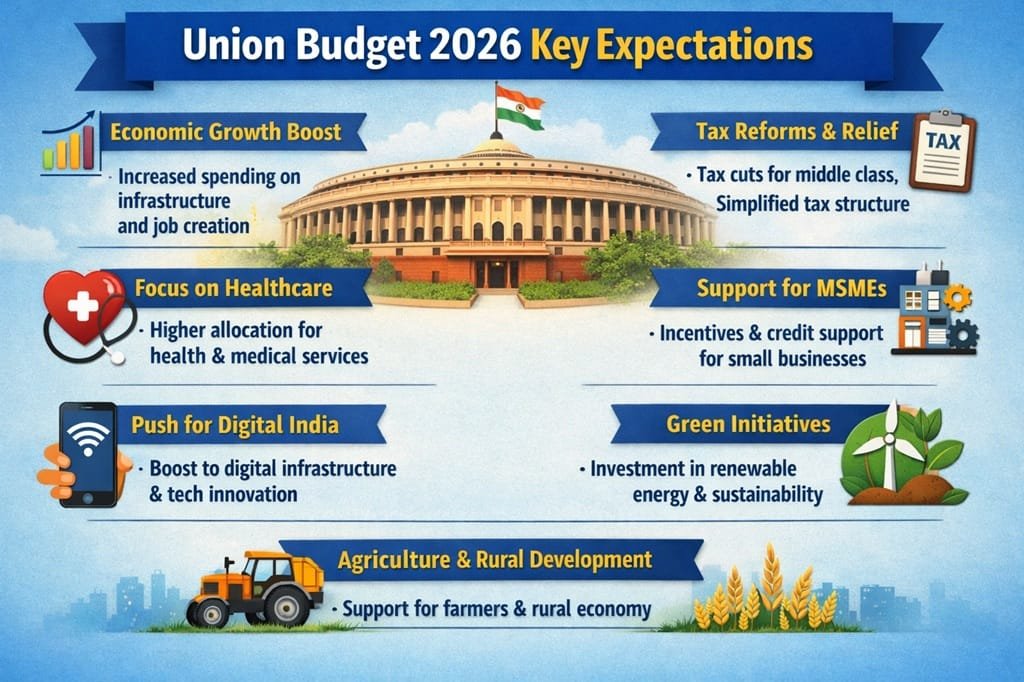
Union Budget 2026 Key Expectations
The government has been focusing on big goals like making India a manufacturing hub and cutting down on imports. The Economic Survey, which came out today on January 31, gives a sneak peek into the economy’s health and where the government might spend more. For instance, it might highlight how inflation has hit the middle class hard, with rising costs for food and fuel. Experts think the budget could aim to keep the fiscal deficit – that’s basically how much the government borrows – at around 4.3% of GDP for the next financial year, down from 4.4% this year. That’s the lowest since before the pandemic, showing a push for careful spending.
Industry groups like FICCI and CII are calling for simpler rules to do business. They want the Goods and Services Tax (GST) system tweaked to cut down on paperwork and make rates more logical. For example, some items have “inverted duty structures,” where raw materials are taxed more than finished products, which hurts small businesses. Fixing that could save companies money and create more jobs.
On taxes, don’t expect huge changes to income tax slabs right away, especially since the new tax regime kicks in fully from April 1, 2026. But there’s talk of making it easier for people to switch over by cleaning up old rules. Last year’s budget made income up to ₹12 lakh basically tax-free under the new system, which was a big relief during high inflation. Now, some analysts suggest bumping up the standard deduction from ₹50,000 to ₹1,00,000 to help salaried folks cope with rising living costs. They also want the 30% tax rate to start at a higher income level, say ₹20 lakh instead of ₹15 lakh, to give the middle class more breathing room.
With the rupee dropping to new lows against the dollar – it hit around 84 rupees per dollar recently – and potential 50% tariffs from the US under the new administration, exports need a boost. The government might announce steps to encourage making things in India that we usually import, like electronics parts. Foreign investors are watching for cuts in transaction taxes or long-term capital gains taxes to pour more money into Indian stocks and bonds. Simplifying capital gains rules is another big ask: right now, different assets have different holding periods and rates, which confuses investors. Harmonizing them could make investing simpler and attract more funds.
There’s also a push for a one-time scheme to settle old tax disputes, like the successful Vivad se Vishwas program from 2020. Over 38,000 cases are stuck in courts, tying up ₹1.5 lakh crore. Letting businesses pay just the principal amount, without penalties or interest, could free up cash for growth. In the old tax regime, the Section 80C limit for deductions on investments like PPF or insurance hasn’t changed from ₹1.5 lakh since 2014. Raising it to ₹2 lakh would encourage more savings. For health insurance under Section 80D, especially for seniors, higher limits are needed because medical costs have skyrocketed – think about how hospital bills can wipe out savings in one go.
Customs duties might get adjusted too. Lower taxes on raw materials for small businesses, manufacturing, electronics, and green energy could help. But higher duties on finished imports would protect local makers, aligning with Make in India and the China+1 strategy, where companies shift production from China to places like India. Sectors like electric vehicles (EVs), solar panels, defense, and semiconductors could get special incentives, like subsidies or tax breaks, to build factories here.
Corporate taxes are likely to stay steady, but startups, green projects, and digital infrastructure might get extra perks. This could include faster approvals for loans or grants for tech upgrades.
Budget 2026 – Expectations from Different Sectors
Every industry has its wishlist. Here’s a closer look at what they’re hoping for, with some real-world context on why these matter.
Electronics and Gadgets
The electronics world is growing fast in India, thanks to schemes like Production Linked Incentive (PLI). But challenges like scarce semiconductor supplies, jumping memory prices, and the weak rupee are hurting. Industry folks want GST glitches fixed – for example, some components face higher taxes than expected. They also seek short-term duty cuts on key parts to keep costs down and compete globally. Building a full ecosystem, from chips to screens, could create millions of jobs. For exports, better logistics help, like faster customs clearance, and refunds on duties paid would make Indian TVs and phones more attractive abroad.
Renewable Energy and Going Green
India aims to hit 500 GW of renewable energy by 2030, but we need more push. The sector wants clear policies for advanced tech like robots in solar farms or efficient wind turbines. Bigger budget allocations for local manufacturing of solar panels and batteries could reduce imports from China. This ties into global climate goals – remember the COP conferences? Support for green bonds or funds would attract eco-friendly investors.
Non-Banking Finance Companies (NBFCs)
These lenders fuel small businesses and infrastructure. They’re not expecting flashy announcements but want smoother operations, like easier access to refinancing from banks. Making rules fair under laws like SARFAESI (for recovering bad loans) would help. With big projects like highways and airports lined up, timely approvals and less red tape could speed things up. MSMEs, which employ over 100 million people, would benefit from targeted credit schemes, especially in villages where NBFCs are key players.
Taxes on Stock Trading (STT)
Securities Transaction Tax adds to trading costs, even after long-term capital gains tax came back in 2018. Traders want it scrapped or lowered for long-term buys, or at least deductible as an expense. Reducing equity gains tax to 10-15% could encourage small investors, who make up a big chunk of the market now with apps like Groww or Zerodha.
Boosting Exports
Exports hit $778 billion last year, but we need more. The government might expand the Export Promotion Mission with ₹25,000 crore more. Ideas include guarantees for small exporters’ loans (up to 85% coverage), cheaper credit, and a platform like BharatTradeNet to cut logistics costs. Labor-heavy sectors like toys, leather, and textiles – which employ lakhs of workers – could get special help, especially with US tariffs looming.
Gold Investments
Gold prices are sky-high due to wars and uncertainty, making it a safe bet. But tax rules are uneven: Gold ETFs become long-term after one year, but physical gold or funds take two. Investors want this fixed to one year for all, helping SIP folks. Reviving Sovereign Gold Bonds (SGBs), which offer interest plus tax perks, would be great since no new ones have come out lately.
Tech and Small Businesses (MSMEs)
MSMEs drive 30% of GDP but struggle with tech. Budget could offer tax breaks for AI, cloud computing, or cybersecurity tools. Easier loans and simpler GST would help them go digital, creating jobs in software and e-commerce.
Electric Vehicles (EVs)
EV sales are booming, but subsidies end soon. Industry wants them extended, especially for bikes, and GST on all parts at 5%. Focusing on the whole chain – from batteries to charging stations – could make EVs cheaper than petrol cars, cutting pollution in cities like Delhi.
Solar Power
Extend PLI to more solar gear and grid tools. Improve schemes like PM Surya Ghar (free solar rooftops) and PM-KUSUM (solar for farmers). New green finance options, like climate funds, could draw billions in investment.
Startups and Innovation
Startups created 1.2 million jobs last year. They want faster funding, fair taxes on ESOPs (employee stock options), and less compliance hassle. This could keep unicorns like Byju’s or Flipkart growing in India.
Defense Sector
With ₹6.8 lakh crore allocated last year, focus now on turning plans into action. Faster orders for local weapons, better repair facilities, and testing labs would strengthen borders and create tech jobs.
Logistics and Transport
Build more ports, rail corridors, and parks under Gati Shakti. Lower GST on warehousing and digital tools would cut costs, making goods move faster across India.
Healthcare
Spend more on kids, moms, and vaccines. Tackle big killers like diabetes and cancer with better hospitals and early checks. Tech like apps for health tracking could save lives, especially in rural areas where doctors are scarce.
Steel Industry
Protect against cheap imports with duties, but lower taxes on inputs. Help with loans for green steel tech to meet global standards.
Education
Upgrade schools with digital tools and train teachers. Cut GST on books and online learning to 0-5%. Use CSR funds for skills training, linking education to jobs in fields like IT or manufacturing.
Fast-Moving Consumer Goods (FMCG)
Extend 0% GST to packaged flour. Subsidies for food processing would help farmers and keep prices low for basics like rice and oil.
Restaurants and Food Services
Lower taxes on dining and restore input credits to offset costs. A dedicated ministry could address issues like licenses and labor laws.
Insurance
Make policies cheaper for rural and small biz folks. Better rules for claims would build trust and cover more people against risks.
Housing and Big Projects
Redefine affordable housing to include bigger cities. Incentives for green buildings could boost real estate, which employs millions.
Farming
Support farmer groups (FPOs) with cash, storage, and market info. This could double incomes, as promised, by cutting waste and getting better prices.
Green Energy Networks
Fill gaps in financing for renewables. Stable policies would attract investors for wind and hydro projects.
Smart Meters for Power
Allocate funds for installing smart meters nationwide. Recognizing them as infrastructure would unlock cheap loans and speed up rollout, reducing theft and improving billing.
All these hopes show how the budget touches every part of life. We’ll know soon if the government delivers on them when the announcement happens tomorrow. In the meantime, it’s a reminder of how policies shape our economy and daily routines

