

Let’s be honest: running a company in 2026 feels a bit like trying to steer a rocket ship through an asteroid field while everyone’s yelling suggestions from the back seat. Markets flip overnight, AI rewrites half the jobs we used to do, employees want purpose more than ping-pong tables, and customers can smell inauthenticity from three time zones away.
In this chaos, technical genius or a killer product isn’t enough anymore. What actually decides whether you explode on launch or glide into orbit? Leadership skills. Plain and simple.
The good news? You don’t need to be born with them. The even better news? The leadership skills every entrepreneur needs in 2026 are shifting fast—and if you grab them early, you’ll lap the competition before they even notice the race started.
I’ve spent the last year talking to founders who raised nine-figure rounds, bootstrappers quietly printing cash, and serial entrepreneurs who’ve crashed spectacularly and come back stronger. Here are the seven core leadership skills they all swear by—plus one wild-card skill that barely anyone is talking about yet (but everyone will be by 2027).
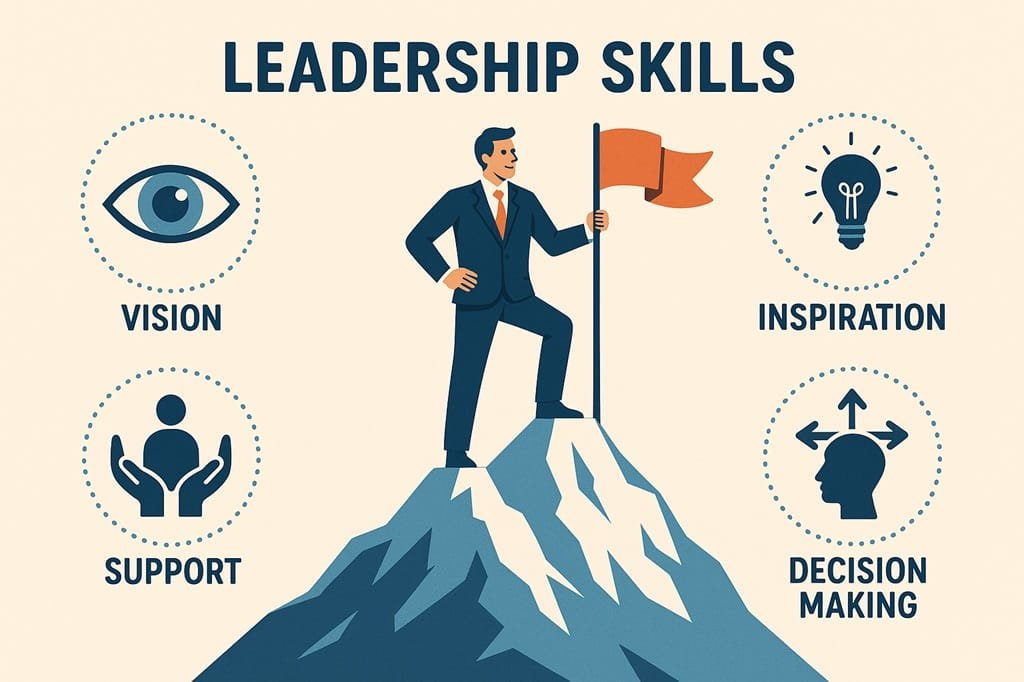
7 Leadership Skills Every Entrepreneur Needs in 2026
Ruthless Adaptability
Remember Blockbuster laughing at Netflix? Or taxi unions swearing ride-sharing would never work? Yeah, those stories feel ancient now, but the same trap is wider open in 2026 than ever.
Having ice-cold adaptability in your leadership skills toolbox isn’t optional—it’s oxygen.
Founders who win today treat their business model like wet clay, not carved stone. One CEO I know pivoted his SaaS company three times in eighteen months—each time looking like a lunatic to outsiders—until the fourth version hit $42 million ARR. His team didn’t burn out; they got addicted to the rush of being right eventually instead of wrong forever.
How to build ruthless adaptability (without losing your mind)
- Run 30-day “what-if” sprints: pick one sacred cow, pretend it’s dead, and force the team to find a replacement.
- Make “I was wrong” a celebrated phrase. Seriously—throw parties for it.
- Read one “this industry is doomed” article every week from a source you normally hate. Force cognitive dissonance; it’s free brain gym.
Radical Empathy
Empathy used to be the soft skill you pretended to have in investor meetings. In 2026 it’s the hardest-edged competitive advantage on the planet.
Employees aren’t “human resources” anymore—they’re volunteers who can ghost you for a better vibe on LinkedIn tomorrow morning. Customers aren’t wallets with opinions; they’re exhausted humans drowning in choices.
The leadership skills every entrepreneur needs now include feeling what your people feel, fast, and doing something about it before they even ask.
One founder I know starts every all-hands with a 10-minute “weather report” where anyone can say how they’re actually doing—no slides, no fixes, just listening. Retention? Through the roof. Output? Somehow higher than when they were “grinding.”
Quick empathy hacks that sound corny but print money
- Do anonymous “start/stop/continue” surveys every sprint.
- Have real conversations with customers yourself—minimum five per week. No sales script.
- When someone burns out, don’t send them a care package. Change the system that burned them.
Asynchronous Decision Velocity
2026 is the year slow decision-making quietly murders more startups than running out of cash.
With teams scattered across twelve time zones, waiting for the perfect Zoom consensus is suicide. The best leaders have mastered making high-quality decisions ridiculously fast—without leaving bodies in the hallway.
This is one of those leadership skills that feels terrifying until you try it, then you wonder how you ever lived without it.
The playbook the fastest teams use
- Default to “advise and consent” instead of consensus.
- Write one-page decision memos (problem, options, recommendation, risks) and ship them in public channels.
- Adopt RICE scoring or ICE scoring religiously—feelings are great, but numbers keep you honest.
- Give yourself (and everyone) permission to be 70% sure and reversible.
One founder told me his company’s internal motto became “Strong opinions, weakly held—updated hourly.”
Narrative Superpower
Investors don’t fund spreadsheets in 2026. They fund stories that make them feel smart for betting early.
Customers don’t buy features. They buy the version of themselves that your product promises.
The leadership skills every entrepreneur needs include the ability to take a messy, technical, boring truth and turn it into a story that spreads like wildfire.
Think about how Elon explains reusable rockets or how Duolingo turned language learning into a guilty-pleasure game. That’s not marketing. That’s leadership.
How to level up your storytelling game tomorrow
- Ban jargon in external comms. If a 12-year-old can’t get it, rewrite.
- Always answer “Why now?” in the first 30 seconds of any pitch.
- Collect customer “before/after” stories like Pokémon cards.
- Practice the “grandma test”: explain your business at Thanksgiving without her eyes glazing over.
Energy Management
You can have all the vision in the world, but if you’re a drained, snappy mess by Wednesday, your team feels it and mirrors it.
In 2026, managing energy beats managing time. The best founders treat their own energy like the company’s most critical KPI.
One CEO schedules “deep recovery” blocks in neon red on the shared calendar—non-negotiable. Another has a “no Slack after 7 pm” rule that he actually follows (gasp).
Non-woo-woo ways to protect the battery
- Track your energy, not your hours. When are you a genius? Protect those windows like gold.
- Make meetings optional by default—yes, really.
- Celebrate wins small and often. Dopamine is free rocket fuel.
- Sleep isn’t a nice-to-have. It’s ROI with pillows.
Ethical AI Fluency
By 2026, if you’re scared of AI, you’re already behind. If you worship it blindly, you’re dangerous.
The leadership skills every entrepreneur needs now include the ability to wield AI like a master swordsman—not a kid who found dad’s gun.
This means knowing when to let AI write the first draft… and when only a human heartbeat will do.
It means building products that use AI without turning into the creepy company everyone screenshots on TikTok.
One founder I respect has a simple rule: “AI can suggest, but humans decide anything that can ruin a life.”
Practical ways to stay ahead without losing your soul
- Make one team member the “AI conscience”—their job is to play devil’s advocate.
- Be brutally transparent about where AI stops and humans start.
- Run “AI-off” days once a quarter to remember what makes you special.
Boundaryless Learning
The half-life of knowledge in 2026 is measured in months, not years.
The moment you think you’ve “figured it out,” you’re toast.
The best leaders I know are voracious learners who treat their ego like a speed bump, not a brick wall.
They’re in Discord servers with 19-year-olds, taking courses on weekends, and asking “stupid” questions in public.
How to stay dangerously curious
- Keep a public “I’m learning” list—turns humility into marketing.
- Read one book outside your industry every month.
- Find mentors ten years younger than you. Yes, really.
- Reward team members for teaching you things.
The Wild Card: Quiet Presence
Here’s the one nobody’s writing Medium articles about yet.
In a world of hot takes, 24/7 Slack, and dopamine-drenched notifications, the rarest superpower in 2026 is the ability to sit in silence without twitching.
Quiet presence is the leadership skill of being fully here—phone down, ego off, attention wide open.
Founders who have it radiate calm in chaos. People trust them instantly. Great talent begs to work for them even when the pay is lower.
I watched one CEO sit through a 45-minute board rant without interrupting once. Just nodding, taking notes, breathing. When the investor finally ran out of steam, the founder said three sentences. The whole room shifted. Deal closed two days later.
How to cultivate quiet presence (starting tonight)
- Meditate five minutes a day. No incense required—just sit and notice your breath.
- Practice “one conversation at a time”—no multitasking people.
- When someone’s upset, try silence first. It feels awkward for ten seconds, then magic.
- Turn off every non-essential notification forever.
Frequently Asked Questions
Q: I’m a solo founder—do I really need leadership skills yet?
A: Yes! You’re leading investors, early customers, future hires, and—most importantly—yourself. Nail these skills early and hiring becomes a breeze.
Q: Which leadership skill should I work on first in 2026?
A: Start with ruthless adaptability. Everything else flows easier when you’re not married to yesterday’s plan.
Q: Isn’t empathy just “being nice”? How is that a competitive advantage?
A: Nice is performative. Empathy is seeing reality through someone else’s eyes and adjusting fast. It’s the difference between retention and churn, loyalty and lawsuits.
Q: What if my co-founder sucks at half these skills?
A: Have the uncomfortable conversation now, not after the Series B. Great companies are built by people willing to grow together—or mature enough to part ways.
Conclusion
In 2026, capital is abundant, ideas are cheap, and AI can code faster than most engineers.
What’s scarce? Humans who can lead other humans through uncertainty without losing their souls—or their teams.
The leadership skills every entrepreneur needs aren’t shiny new frameworks. They’re ancient human truths, pressure-tested by the fastest-moving economy in history.
Master ruthless adaptability, radical empathy, asynchronous velocity, narrative superpower, energy mastery, ethical AI fluency, boundaryless learning, and that quiet presence nobody sees coming…
…and you won’t just survive 2026.
You’ll shape it.
So go ahead—sharpen these Leadership Skills, embrace the future, and build something extraordinary in 2026 and beyond!

