

The rule of Capital Gain Tax calculation on the sale of property is modified in the Budget 2024. The indexation benefit is now removed. Before the Budget 2024, the long-term capital gain from the property sale was taxed at 20% with indexation benefits. Now as per the budget indexation benefit is removed and the tax rate is reduced to 12.5%. This leads to increased tax liability for individuals planning to sell their property. Let’s try to understand this in detail along with examples.
LTCG on Sale of Property – Indexation Benefit Removed
The new rule of removing the indexation benefit increases tax liability to the property seller.
Let us say you purchased the property for ₹50 lakhs a few years back. Now, you need money and you have a buyer. You sell the property at a rate of ₹60 lakhs. The actual profit in this case would be ₹10 lakhs. Now under the old provision, the seller was able to take benefit of the Cost Inflation index while adjusting the purchase price and paying a tax. The CII (Cost Inflation Index) is declared by the Income tax department.
Now, with the new rule, taxpayers need not adjust the purchase price based on CII. The actual purchase and sale prices need to be considered while calculating tax liabilities.
Old Long-Term Capital Gain Tax Provision on Property
Purchase Price of Property – ₹50 lakhs
CII Adusted Purchase Price – ₹64.8 lakhs
Sale Price of Property (2024-25) – ₹75 lakhs
Profit – ₹10.2 lakhs
Tax liability under old LTCG Rule (20%) – ₹2.04 lakhs
New Long Term Capital Gain Tax Provision on Property
Purchase Price of Property – ₹50 lakhs
Sale Price of Property (2024-25) – ₹75 lakhs
Profit – ₹ 25 lakhs
Tax liability under the new LTCG Rule (12.5%) – ₹ 3.125 lakh
From the above example, it is clear that although the tax rate is reduced to 12.5% as the indexation benefit is removed tax liability of the taxpayer is increased. The new rule applies to all unlisted assets like real estate, gold, silver, etc.
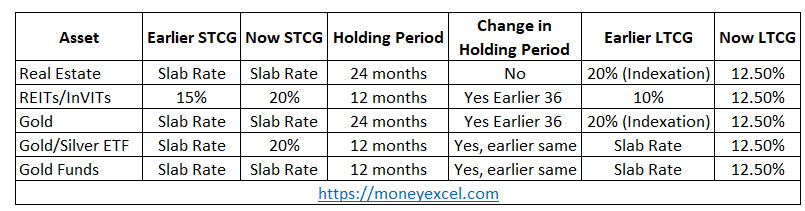
The new rule is applicable only on the property purchased after the year 2001. The indexation benefits for properties bought till 2001 will continue. This means if the property is purchased before 2001 you can get indexation benefit on that property. If such property is sold capital gain tax shall be calculated after factoring in indexation based on the price in 2001 or the price at which it was bought plus indexation till 2001 whichever is lower. Property bought after 2001 will be taxed at a flat rate of 12.5%.
The long-term capital gain tax on unlisted financial assets is applicable if the holding period is above 2 years. Short-term capital gain tax is applicable if the holding period is less than 2 years. There is no change in rollover benefits that are available under the I-T Act. So, the taxpayers who want to save on LTCG tax with low rates can continue to avail of the rollover benefits after fulfilling the conditions.
FAQs
What is the LTCG Rate on Property?
The LTCG tax rate on property sales is reduced from 20% to 12.5%. The new applicable LTCG Rate on Property is 12.5%. The indexation benefit of the purchase price is removed.
How can I avoid LTCG on the Sale of Property?
Section 54 exempts you from paying LTCG tax on the sale of property if you acquire a new house either one year before or within two years of selling your old property.
How to calculate capital gain tax on Property?
The calculation of Capital Gain Tax is simple –
(Sale Price – Purchase Price) x Applicable Tax Rate
What is a period of Holding for LTCG?
For property, gold, silver, and any other unlisted assets the holding period is 2 years for LTCG. In case the asset is sold before 2 years short-term capital gain tax is applicable.

