

You should check the Claim Settlement Ratio before buying an insurance policy. Let’s be honest — buying insurance isn’t exactly what dreams are made of. It’s not like shopping for the latest iPhone or planning your next exotic vacation. But here’s the kicker: it could be the one decision that saves your family from a financial nightmare. And while most folks are laser-focused on premiums and perks, there’s one thing they often miss — Claim Settlement Ratio.
Life insurance is like a safety net for your family. You buy it so that if something unexpected happens to you, your loved ones do not struggle with money for daily needs, loans, or education. Most of us pick a plan thinking only about the monthly premium – the smaller, the better, right? But there is something even more important hiding in plain sight. What if the insurance company delays the money or, worse, says no to the claim when your family needs it the most?
This is where the Claim Settlement Ratio, or CSR, comes in. It is a simple number that shows how trustworthy an insurance company really is. In this detailed guide, we will explain everything about CSR in easy words, step by step. We will add real examples, latest updates from 2026, extra tips, and even helpful diagrams so you can feel confident while buying or claiming life insurance. Let’s make sure your family gets the support they deserve without any stress.
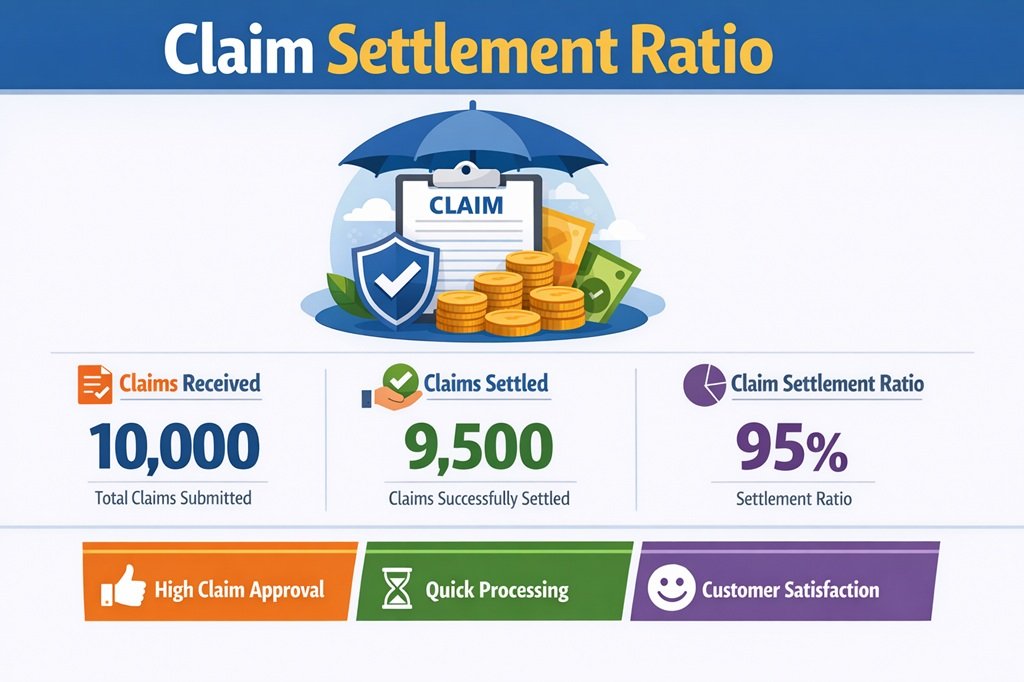
What Exactly Is Claim Settlement Ratio?
Imagine you run a small shop. Every day customers come and ask for refunds on faulty items. If you give refunds to 97 out of 100 customers, people will trust your shop. The Claim Settlement Ratio works the same way for insurance companies.
CSR is the percentage of claims the company actually pays out compared to the total claims it receives in a year. A high CSR means the company keeps its promise most of the time. IRDAI, the watchdog for insurance in India, collects this data every year and shares it publicly so customers like you and me can check easily.
Why does this matter so much? Because when you buy a term plan or any life cover, you are not just paying premiums – you are buying peace of mind for your spouse, children, or parents. A low CSR can leave your family in deep trouble at the worst possible time.
How Is Claim Settlement Ratio Calculated? (With Easy Examples)
The formula looks a bit technical, but it is actually straightforward. Here it is:
CSR = (Total Number of Claims Settled in the Year / (Claims Carried Forward from Last Year + Total Claims Received This Year)) × 100
Let’s break it down with a real-life style example. Suppose an insurance company starts the year with 20 old claims still pending. During the year, they receive 980 new claims. They manage to settle 950 claims in total. Plugging in the numbers:
CSR = (950 / (20 + 980)) × 100 = 95%
That means 95 out of every 100 claims were paid. Pretty good, right? But remember, this number includes all types of claims – death claims, maturity, surrender, etc. IRDAI also shares separate data for “individual death claims settled within 30 days”, which is super important for families because quick money helps during tough times.
As of the latest IRDAI report for the financial year 2024-25 (released in early 2026), the entire life insurance industry in India settled 97.10% of individual death claims within 30 days. Private companies did slightly better at 97.30%. Many top players reached 99% or even 100%. This shows the industry is getting stronger every year with better technology and processes.
What Makes a “Good” Claim Settlement Ratio?
Anything above 95% is excellent in today’s world. Earlier, people used to say 80% or more is okay, but now with better systems, we expect much higher. Here are some quick benchmarks:
- Below 90%: Be careful – it may mean delays or more rejections.
- 95% to 98%: Very reliable.
- 99% or 100%: Top class – your family is in safe hands.
But CSR is not the only story. You should also check how fast they pay (less than 30 days is ideal) and how much money they actually pay out (some companies settle most small claims but struggle with big ones). The latest data shows private insurers like Aditya Birla Sun Life, HDFC Life, PNB MetLife, and Shriram Life often touch perfect scores in quick settlements.
Factors That Can Lower the Claim Settlement Ratio
No company wants to reject claims – it hurts their reputation. But sometimes claims get rejected because of simple mistakes. Here are the main reasons, explained simply:
- Hiding or Wrong Information at the Time of Buying This is the biggest reason. If you forget to mention a health problem, smoking habit, or another policy you already have, the company may call it “non-disclosure” later and reject the claim. Be 100% honest in the form – it takes only a few extra minutes but saves years of trouble.
- Wrong or Missing Nominee Details Imagine your family fighting in court just because the name or relationship of the nominee is written wrong. Always double-check and update after marriage, birth, or any big life change.
- Policy Has Lapsed If you miss premium payments and the policy stops, the cover ends. No claim possible. Set up auto-debit or reminders.
- Death Due to Excluded Reasons For example, suicide in the first few years or death during adventure sports not covered. Read the policy document carefully.
- Incomplete Documents Missing death certificate, medical reports, or bank details can delay or stop the process. Keep a folder ready with copies.
- Cover Amount Too High If your total insurance is more than what your income supports (called Human Life Value), the company may question it.
Other less common reasons include fraud suspicion or claims filed very late. The good news? Most rejections can be avoided with careful steps.
Step-by-Step Claim Process – What Actually Happens
When a claim happens, it is not instant magic. Here is what usually takes place (see the flowchart above for a visual):
- The nominee informs the company within a reasonable time.
- They fill a simple claim form and attach documents (death certificate, policy papers, identity proof, bank details).
- The insurer checks everything. For death claims, they may investigate (but only up to 90 days as per IRDAI rules).
- If everything is correct, money reaches the bank account – often in less than 30 days.
- If something is missing, they politely ask for more papers or explain the rejection in writing.
Today, most companies allow 100% online filing through apps or websites, which makes it faster and paperless.
How to Check the Claim Settlement Ratio of Any Company
It is super easy and free:
- Go to the official IRDAI website (irdai.gov.in).
- Look for “Handbook on Indian Insurance Statistics” or “Claim Settlement Ratio” section (latest one is for 2024-25).
- You can also search Google with “IRDAI CSR 2026 life insurance” – many trusted sites like Policybazaar or company pages show clear tables.
- Compare at least 5-6 companies before buying.
Do this every year because numbers can change slightly.
Smart Tips from Policyholders to Make Your Claim Smooth
The company is not alone in this journey – you also have a big role. Here are practical tips that thousands of families have used successfully:
- Fill every form truthfully and completely.
- Read the policy wordings at least once (especially the exclusions part).
- Update your address, phone, email, and nominee regularly through the app.
- Tell the insurer immediately if you develop any new illness or change job.
- Keep all policy documents, premium receipts, and medical records in one safe place (cloud backup is even better).
- Choose a company that offers video claim filing or 24×7 helpline.
- Buy from a trusted advisor who explains everything clearly.
- Pay premiums on time – set calendar alerts or auto-pay.
- Understand the “contestability period” (usually first 3 years) – extra care needed during this time.
If you follow these, the chance of rejection drops almost to zero.
Other Important Numbers to Check
While CSR is the star, look at these too:
- Solvency Ratio (should be above 1.5 – shows the company has enough money to pay all claims).
- Incurred Claim Ratio (how much of the collected premium goes back as claims).
- Customer complaint ratio (lower is better).
- App ratings and Google reviews from real claimants.
A company strong in all these areas will give you true peace of mind.
Frequently Asked Questions
Q: Can CSR be 100%?
Yes, several companies achieve it every year for death claims.
Q: Does CSR include only death claims?
No, but IRDAI separately shows death claim data, which matters most.
Q: What if my claim is rejected?
The company must give reasons in writing. You can appeal to the insurer’s grievance cell, then IRDAI, or even the Insurance Ombudsman – all free.
Q: Is IndiaFirst Life’s CSR good?
Check the latest IRDAI numbers yourself – numbers change yearly, so always verify.
Q: How long does settlement take?
Most genuine claims are settled in under 30 days now.
Q: Should I buy only from the highest CSR company?
No. Also compare premium, features, and service. A balanced choice is best.
Final Thoughts
Buying life insurance is an act of love. By understanding the Claim Settlement Ratio and following the simple steps above, you turn that love into real security. Do not choose only on premium or fancy ads. Take five minutes to check CSR, read the policy, and ask questions. Your family will thank you later.
Remember, if you declare everything correctly at the start and keep things updated, the claim process becomes smooth and stress-free. Life is uncertain, but your insurance should not be.
Stay safe, stay informed, and give your loved ones the protection they truly deserve. If you have any doubt, talk to your insurance advisor or visit the IRDAI website today. A small effort now can bring huge relief tomorrow.

