

The Composite Claim Form – EPF withdrawal Death Cases is a crucial document for accessing the EPF funds of a deceased loved one.
It is already very traumatic losing someone from the family, but having to deal with government documents at such a time is even more difficult. However, in case the deceased person had been making contributions towards his EPF account, then his family members are entitled to three distinct payouts which include the total sum in his EPF account, a pension according to EPS and life insurance claim under EDLI. All of these can be availed using a composite claim form for EPF withdrawal in case of death.
A nominee or legal heir of the deceased member can withdraw EPF, insurance claim, and pension using this form. In this guide, I will help you understand the Claim Form and the process of filling and submitting the form.
Also Read – One Member One EPF Account – How to Transfer EPF Account?
Composite Claim Form – EPF withdrawal Death Cases
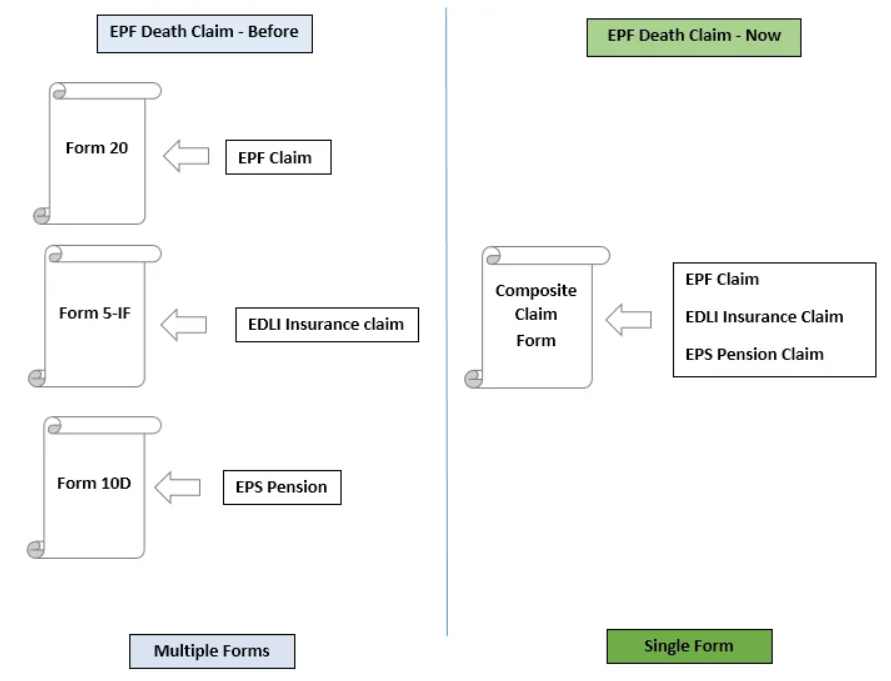
In the past, the Employees’ Provident Fund Organisation (EPFO) required claimants to submit three different types of forms in order to claim the benefits in case of death of any member. These three forms include Form 20 in relation to last PF settlement, Form 10D for claiming family pension under EPS and Form 5IF in respect of EDLI insurance claim. In order to make the process more efficient and less time-consuming, EPFO introduced the concept of composite claim form for the purpose of death cases.
Since the claimant will now be filling just one form as compared to three, he would have to provide information regarding himself/herself and his/her bank only once, provide same set of documents as annexure to just one form which can be either submitted through employer or directly to regional office of EPFO.
It should be noted that this composite claim form for death cases is not same as general composite claim form (Aadhaar/Non-Aadhaar) which enables living members to merge Form 19, Form 10C, and Form 31 for withdrawing their PF/pension/advance.
The Composite Claim Form is an essential document for those looking to withdraw EPF funds due to various reasons, including the death of the account holder. It combines multiple forms into one, simplifying the process for claimants.
Key Features
- Simplification – Merges multiple forms into a single document.
- Versatility – Can be used for withdrawals due to retirement, resignation, or death.
- Ease of Use – Designed to be user-friendly, reducing the paperwork burden.
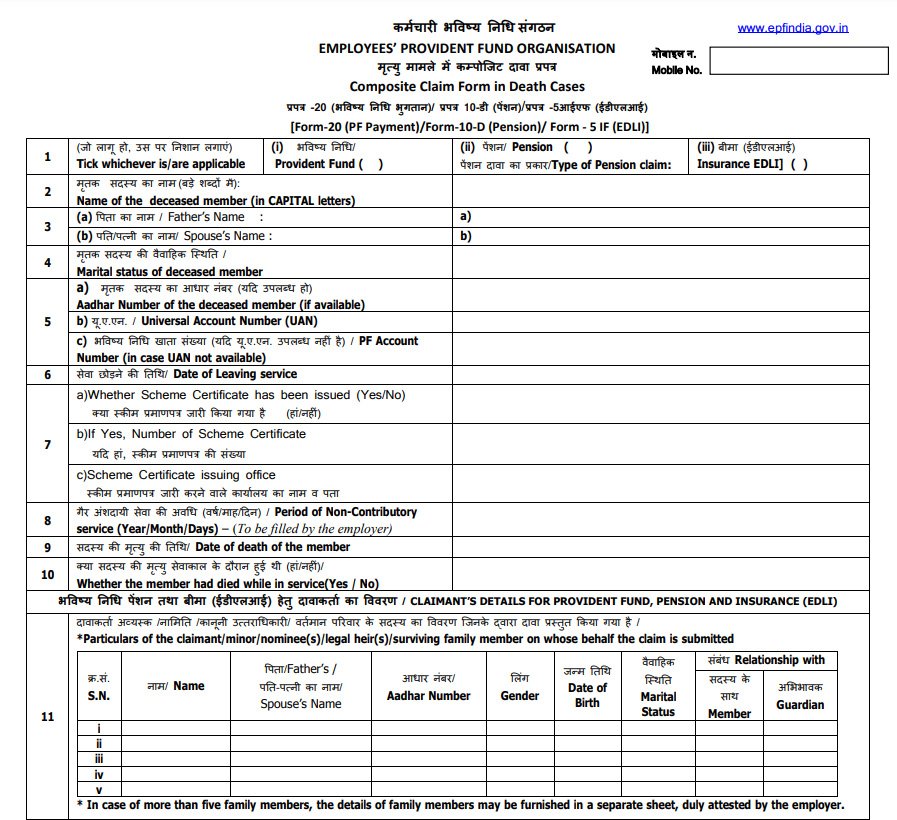
The screenshot of the Composite Claim Form applicable in the death case for EPF withdrawal is given below.
Who is Eligible to File a Claim Under the Composite Claim Form?
Under the EPF Scheme, the eligibility to file a claim takes the following order of priority:
- Nominee – In case the deceased member had submitted Form 2 (e-nomination online) appointing a nominee, he/she becomes the eligible claimant for the PF account balance and EDLI amount.
- Immediate family members – In the absence of any nomination, immediate family members such as spouse, minor children (even if born after the date of death of the member), and dependants (parents) are considered the eligible claimants by the EPFO.
- Legal Heirs – In case the deceased member does not have any family member as per the scheme, the claim can be filed by legal heirs using a legal heir certificate / succession certificate from the relevant civil authorities.
In case of EPS family pension, the eligible claimants are the surviving spouse and minor children (upto 25 years). A certain share for each of the dependants has been set out in the scheme.
Nominations play the most important role in the entire claiming process. The lack of it will require additional documents to be filed to establish the claimant of the funds.
Step-by-Step Guide to Filling the Composite Claim Form
Filling the Composite Claim Form for EPF withdrawal in cases of death can be overwhelming, particularly in such a stressful period. Here is a detailed guide to assist you with the procedure.
Step 1: Gather Necessary Documents
Before you start filling out the form, make sure you have all the required documents. This includes –
- Death certificate of the EPF account holder
- Joint photograph of all the claimants
- Date of Birth certificate of children claiming pension
- Legal heir certificate or succession certificate
- Proof of identity and address of the claimant(s)
- Bank details of the claimant(s)
- For verification of bank accounts, a copy of the cancelled cheque or attested copy of first page of bank Pass Book.
Step 2: Fill Out the Claimant’s Details
This section requires the personal details of the claimant(s) –
- Name
- Relationship with the deceased
- Address
- Contact information
Step 3: Provide Details of the Deceased
You’ll need to fill in details about the deceased EPF account holder, including –
- Name
- EPF account number
- Date of death
Step 4: Bank Details
Provide the bank account details where the EPF funds should be transferred. This should be an account in the name of the claimant(s).
Step 5: Nominee/Legal Heir Details
If the deceased had nominated someone for their EPF account, provide the nominee’s details. If not, provide the details of the legal heir(s).
Step 6: Attestation and Submission
Once the form is filled out, it needs to be attested by the employer or a gazetted officer. After attestation, submit the form to the regional EPF office.
Download Composite Claim Form – EPF withdrawal Death Cases
Typical Causes for Delays or Rejection
Inconsistency in claimant details – inconsistency between names, date of birth, or spellings in Aadhaar, PAN, and bank accounts is one of the most common reasons for the rejection of claims.
Nomination missing – in the absence of Form 2, EPFO asks for proof of succession either in the form of legal heir or succession certificate; the latter takes time to get issued by the civil authorities.
Lack of valid signature or attestation – the claim will fail in case it does not have valid signatures/seals or attested copy by another authorized person.
Wrong or unverified bank details – the bank account number of the claimant should be active and correctly mentioned to process the claim.
These could be avoided if one takes care to update KYC details on UAN portal ahead of time, ensure consistency of personal details in all documents, and fill Form 2 while the member is alive, reducing the claim period to weeks from months.
Conclusion
You need to fill and submit the Composite Claim Form – EPF withdrawal Death Cases. By following the steps outlined in this guide, you can navigate the process with greater ease and ensure that the financial benefits reach the rightful beneficiaries. Remember, it’s always a good idea to seek help if you’re feeling overwhelmed—be it from a trusted family member, a financial advisor, or a legal professional.
With the Composite Claim Form, EPFO has made it much easier for the family to make an effort that previously involved completing three different forms. With the consolidation of EPF settlement claim, EPS pension and EDLI insurance claim into one single form, the amount of paperwork required has been drastically reduced as well as the waiting period. It is most crucial to make sure that your KYC details are absolutely correct and have all the documents together along with the attestation from your employer; these three things play a very crucial role in ensuring that the family gets their dues quickly.
In case your claim is pending or rejected multiple times, EPFiGMS (EPFO’s grievance redressal portal) should be approached along with regional office help desks.

